
March Code
Service

Software Support and Maintenance

We stay on call under an SLA, fix incidents and patch CVEs, so you learn about an outage from our report, not from your customers. From $2,900/month with 10 hours of development; the typical plan is $6,900/month with 20 hours. A project health audit is free, takes 3–5 days and comes before any contract. Month-to-month contract, 30 days' notice to exit

Review in 3–5 daysfree, before any contract
from $2,900/monthmonth-to-month contract
13+ yearsof founder experience · US, Europe, CIS

Free consultation · 30 minutes · No obligation

Cost
from $2,900/month
First step
A project health audit in 3–5 days, free
First paid stage
Standard plan: from $2,900/month
  • Quote in 24 hours
  • Pay by stage
  • Your code from day one
  • Weekly demos
  • 3-month warranty
  • Contract and invoices

Telegram @marchcode · info@march-code.tech · Mon–Fri 9:00–18:00 Central European time, and on Telegram we reply outside these hours too

When it matters

Situations where we help

If you recognize even one, we can be useful

01

Your contractor vanished, and the system is in production

No reply for a week, a rate that suddenly doubled, or a contractor who simply disappeared. Nobody knows where the access credentials and documentation are, and no one has looked at the code in two years. Every day without maintenance is a risk you don't control.

02

Alerts come in, and no one is there to respond

Maybe you do have monitoring, but nobody watches it at 3 a.m. For an online store, 4 hours of downtime at night means a whole shift's revenue lost. For a B2B SaaS, it means an SLA penalty and a damaged client relationship.

03

Dependencies haven't been updated in a year, and CVEs are open

Frameworks and libraries are 3–5 versions behind. CVE vulnerabilities are unpatched. One public data leak, and the reputational damage costs far more than a year of support.

Let's estimate the budget for your task

Describe your task and we'll come back with a timeline and cost estimate within 1 business day. Not ready for a quote? Start with a free review: the report stays with you either way.

Get a quote
What you get

Features and benefits

Concrete results we deliver for you

01

An on-call engineer, not just a dashboard

Monitoring catches the incident and wakes the on-call engineer, not you. Every common failure has a runbook, and escalation is written into the contract. An alert gets handled within minutes, before users notice anything.

02

Critical bugs: response from 15 minutes to 4 hours, depending on the plan

The SLA on response and resolution comes with financial liability: if we miss a deadline, we deduct it from the next invoice using the formula in the contract, not in a slide deck. Transparent ticket tracking: you see the status of every incident in real time.

03

Dependencies and CVEs patched on schedule

Scheduled updates of frameworks, libraries and the OS with no downtime. We check compatibility, test in staging and roll out to production; you get a notification once it's done.

04

Performance under control, with numbers in the report

Bottleneck profiling, SQL query optimization, caching, CDN. Every month the report shows the response times of key user flows before and after, so you see the improvement in numbers, not promises.

05

SLA up to 99.95% with a financial guarantee

Three levels: Standard (99.5%), Premium (99.9%), Enterprise (99.95%, 24/7 on-call and a priority queue). Uptime is measured by external monitoring that you can access too, so you look at the same charts we do.

06

A monthly report with an improvement plan

The number of incidents, the response time for each, actual uptime, hours used and hours left. Plus specific recommendations for next month. We'll show you a sample report during the free audit.

Process

How we work

A transparent process with clear stages and deliverables

1
Stage 1

Project health audit: 3–5 days, free

After a 30-minute call, we go through production, the incident history, backups, dependencies and access. You get a written report: the three most expensive risks, whether restoring from backup actually works, and an honest answer on whether you need a subscription at all. You keep the report. All before any contract, and we don't touch production.

2
Stage 2

Onboarding and handover: 1–2 weeks

Code, access, documentation, interviews with the previous team and an overlap period if that team is available. If the contractor has vanished completely, we reconstruct the picture from the code and infrastructure. We agree on the SLA.

3
Stage 3

Monitoring and alerts: 1 week

We set up or extend monitoring: uptime, performance, errors, security. We configure alerts, escalations and the on-call schedule. We write runbooks for common incidents.

4
Stage 4

Ongoing support: every day

Daily monitoring, incident response under the SLA, bug fixes, dependency updates, improvements within the included hours.

5
Stage 5

What comes next is your call

The code, access, monitoring and runbooks stay yours. If you want to move to a smaller plan, bring support in-house or leave, give 30 days' notice, and we hand over the documentation and incident history.

Cost and timeline

What it costs

You get an exact quote within 24 hours of the call

Cost
from $2,900/month
What's included
  • Start free: a project health audit in 3–5 days. The three most expensive risks, plus the state of backups, dependencies and CVEs. You keep the report, and we don't touch production
  • Standard, from $2,900/month: 4-hour response, 24-hour resolution, 99.5% uptime, 10 hours of development a month
  • Premium, $6,900/month: 1-hour response, 8-hour resolution, 99.9% uptime, 20 hours of development; the typical plan for a live product
  • Enterprise, quoted individually: 15-minute response, 24/7 on-call, priority queue, 99.95% uptime, 40 hours of development
  • Month-to-month contract, 30 days' notice to exit. The code, access, monitoring and runbooks stay yours

The final cost depends on scope. We'll work it out after a short call.

Prices shown are indicative and for information only; they are not a binding offer. The final cost is set in the contract once the project requirements are agreed.

Maintenance: your product keeps living after release

Support isn't "we fix it when it breaks"; it's a routine: SLA on-call duty, backups with tested restores, dependency updates and development hours built into the plan. We start for free: a 3–5 day project health audit covering the three main risks and the state of backups and CVEs, and you keep the report before any contract. Then Standard from $2,900/month with 10 hours of development, Premium at $6,900/month with 20 hours, and Enterprise with 24/7 on-call, quoted individually. Month-to-month contract, 30 days' notice to exit. What goes into the price is covered in our article on website support costs, and the price ranges for every service are on the pricing page.

Proof, not a list of technologies. An ERP/FSM platform has been in production since 2019 and handles 500+ work orders a day; it's run by the same people who designed it, and the client's revenue has tripled. SHATE-M: we support it after launch, with a catalog of 500,000+ items, 70% of orders placed online and integration with 1C (a popular ERP and accounting platform in Eastern Europe). MarchTracker is our own product on iOS, Android and the web: we run on-call duty for it under the same routine we sell.

Where we're not the right fit. If you need to build the setup itself (CI/CD, monitoring, infrastructure), that's DevOps, a one-off project from $4,900. If you need decisions and priorities rather than on-call duty, that's CTO as a Service. If you need hands in sprints rather than an SLA, that's a dedicated team. If your system has grown a layer of manual data transfers, look at system integration. And for a simple WordPress business website, a basic agency maintenance plan is enough, and we'll tell you so.


Case studies

Real results

Projects where we applied this service

Case study: ERP/FSM Platform for Managing Contractors in the US
15 minfrom request to crew assignment, down from 28

ERP/FSM Platform for Managing Contractors in the US

Contractor management

An ERP/FSM (field service management) platform for running field service crews and contractors in the US. It covers the full cycle in one window: request intake, dispatching, GPS tracking of crews, job completion control, billing and analytics. It comes with a mobile app for crews with photo reports and offline mode.

15 minfrom request to crew assignment, down from 28
since 2019platform in production
1 systemrequests, GPS, billing and analytics

«This team built a platform that holds up under 3x business growth. The dispatcher sees every crew in real time and billing runs on its own, so we no longer close the month two weeks late. The team really got the specifics of field service in the US.»

— Raz Bajwa, CEO

Case study: ERP modernization and a B2B portal for an auto parts distributor
70%of orders go through the portal

ERP modernization and a B2B portal for an auto parts distributor

Auto parts and distribution

Experience from our CTO's portfolio: ERP modernization and the launch of a B2B portal for a large auto parts distributor with a catalog of 500,000+ items. 1C (a popular ERP and accounting platform in Eastern Europe) connected via REST API, search by VIN and cross-reference numbers through TecDoc, dealer accounts with personal pricing. The project was completed before March Code was founded.

70%of orders go through the portal
500K+catalog items with VIN search
into 1Corders arrive with no manual entry

«Dealers stopped calling managers to ask whether something is in stock: they see the stock in the portal themselves. An order takes minutes and goes into 1C without anyone retyping it. Within a year, 70% of our total turnover went through the portal, and that changed how our sales department works.»

— Sergey Deineko, Business Development Director

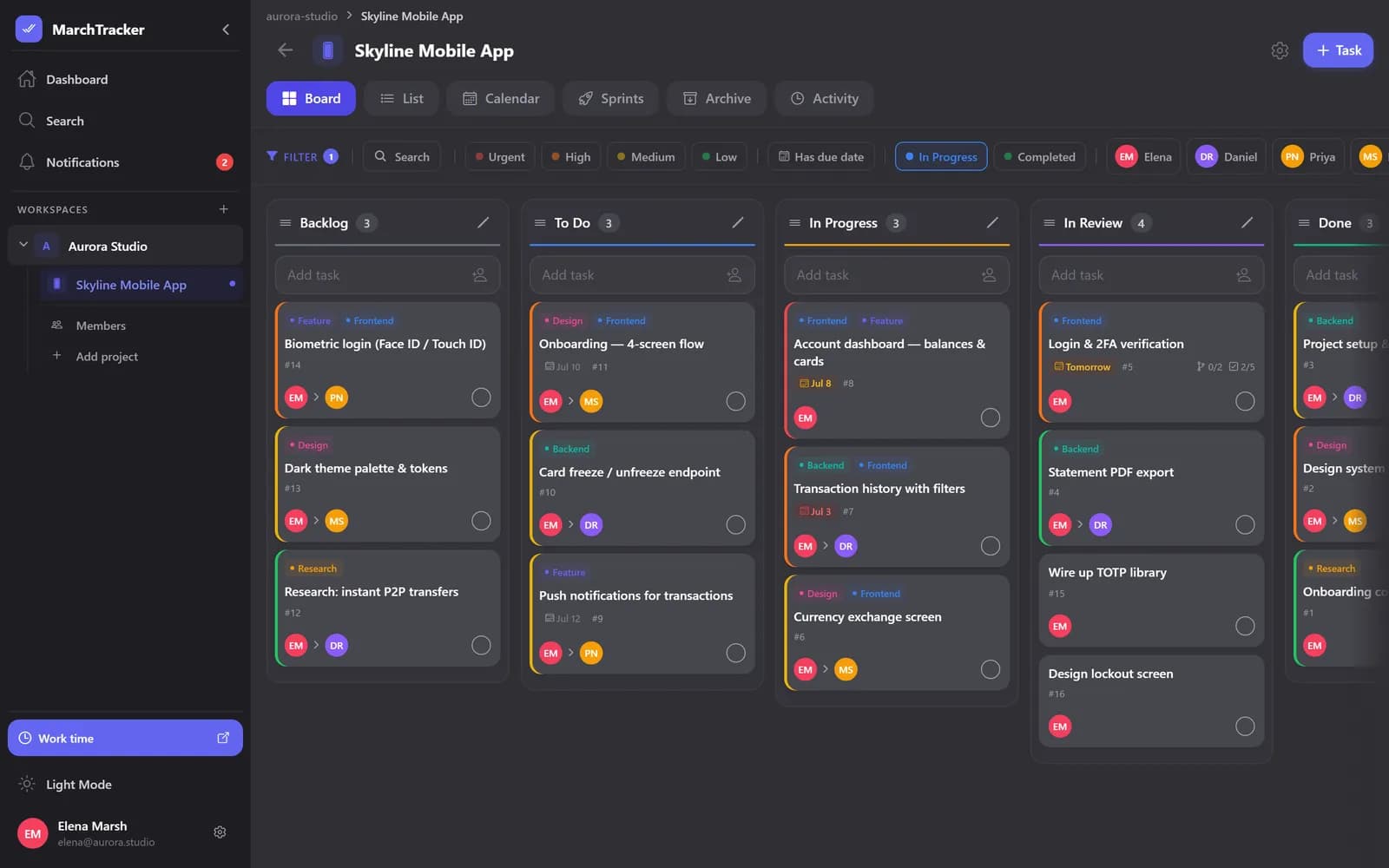
Case study: MarchTracker: A Team Task Tracker for iOS, Android and Web
3 platformsfrom one codebase

MarchTracker: A Team Task Tracker for iOS, Android and Web

Product SaaS

Plan, sprint and ship in one fast workspace. Kanban boards, sprints, a calendar, built-in time tracking and real-time collaboration: one Expo / React Native codebase and a NestJS backend.

3 platformsfrom one codebase
6 viewsof one project
Real-timethe whole team on one board
2 in 1task tracker + time tracking
FAQ

Frequently asked questions about Support

Answers to the questions we hear most often

A project health audit in 3–5 days, free

Audit free · support from $2,900/month

Prices are indicative and not a binding offer.

On a 30-minute call we go through what's in production, who fixes it today and where it breaks. In 3–5 days you get a written report: the three most expensive risks, the state of backups and dependencies, and an honest answer on whether you need a support plan at all. You keep the report. All before any contract, and we don't touch production.

Step 1 of 2 · Task

Ask about support on Telegram, no form

Keep exploring

Read next

DevOps and CloudService

DevOps and Cloud

We build infrastructure your product doesn't fall over on: CI/CD and one-click deploys, monitoring that alerts you before customers do, Kubernetes only where it's justified, cloud migration with no production downtime. A baseline setup starts at $4,900 and takes 2–3 weeks; an infrastructure audit and a demo pipeline are free in 3–5 days. We don't touch production before a contract is signed.

Learn more
IT OutsourcingService

IT Outsourcing

IT outsourcing and developer staff augmentation: dedicated engineers on your backlog, working in your sprints and your repository. Free backlog review in 3–5 days, an engineer from $5,900/month, a trial sprint for $3,900.

Learn more
How Much Does Website Maintenance and Development CostArticle

Pricing · 15 min

How Much Does Website Maintenance and Development Cost

How much website maintenance costs: basic from $500/month, extended from $2,900/month, ongoing development from $6,900/month. What each plan includes and when it's time to bring in a team.

Learn more
How to Choose a Software Development Company: 10 CriteriaArticle

Guides · 15 min

How to Choose a Software Development Company: 10 Criteria

10 proven criteria for choosing a software development company, from portfolio and tech stack to the contract and post-launch support. Plus a checklist, red flags and common mistakes.

Learn more