
March Code
Service

Custom ERP Development

An ERP built for your production instead of a patchwork of accounting software, Excel and homegrown tools. The first module in production from $14,900 in 6–8 weeks, then one at a time. A process map and a module prototype free in 3–5 days

Demo in 3–5 daysfree, before any contract
from $14,900transparent quote
13+ yearsof founder experience · US, Europe, CIS

Free consultation · 30 minutes · No obligation

Cost
from $14,900
First step
A map of where you lose money and a first-module prototype in 3–5 days, free
First paid stage
First module in production: from $14,900, 6–8 weeks
  • Quote in 24 hours
  • Pay by stage
  • Your code from day one
  • Weekly demos
  • 3-month warranty
  • Contract and invoices

Telegram @marchcode · info@march-code.tech · Mon–Fri 9:00–18:00 Central European time, and on Telegram we reply outside these hours too

When it matters

Situations where we help

If you recognize even one, we can be useful

01

Every department has its own system, and nothing adds up

Accounting software for bookkeeping, Excel for planning, a homegrown tool for the warehouse, WhatsApp for the shop floor. Stock levels in three places don't match, the summary report takes two days to put together by hand, and by the time it's ready it's out of date.

02

Your off-the-shelf ERP can't handle your BOM and subcontracting

A manufacturer tries to run MRP planning in a standard ERP, but the configuration doesn't cover its specifics: subcontracting, scheduling by machine load. The result: 2–3 days to build a weekly plan and 30% overproduction.

03

A year implementing an ERP, and it never took off

The integrator quotes a big budget and 12 months, the payments keep going out, and the shop floor still runs on paper shift assignments. A modular approach removes that risk: the first module goes live in 6–8 weeks, so you see results before most of the budget is spent.

04

You estimate unit costs by eye and sell at a loss

Production can't accurately allocate materials, labor and overhead, so prices are set roughly. Some products sell at a loss, others are overpriced and lose to competitors.

Let's estimate the budget for your task

Describe your task and we'll come back with a timeline and cost estimate within 1 business day. Not ready for a quote? Start with a free review: the report stays with you either way.

Get a quote
What you get

Features and benefits

Concrete results we deliver for you

01

A single source of truth for every department

Production, warehouse, sales, finance and HR in one system. The CEO sees a consolidated real-time dashboard without collecting data from 5 departments.

02

MRP planning: the right purchases, the right production

Material requirements are calculated automatically from the production plan. Overproduction drops by 20–30%, material shortages by 80%.

03

Unit costs calculated automatically, to the cent

Direct materials, labor and overhead are allocated automatically to every unit produced. You see the margin on every product in real time.

04

Real-time dashboards for management

Revenue, production load, warehouse stock, receivables, all on one screen. In our ERP/FSM case, a platform like this handles 500+ service requests a day, and the client's revenue tripled in 18 months.

05

Integration with accounting, equipment and IoT sensors

The ERP connects to your accounting system (QuickBooks, Xero, NetSuite, SAP Business One), machines (OPC UA), temperature and humidity sensors, and your online banking. Data flows in automatically, with no manual entry.

06

Mobile access for the warehouse and the shop floor

Warehouse staff scan barcodes with a phone, the shop floor supervisor sees plan vs. actual on a tablet. It works offline and syncs once the connection is back.

Process

How we work

A transparent process with clear stages and deliverables

1
Stage 1

Process review and module prototype: 3–5 days, free

After a 30-minute call we show you a map of where the business loses money and which module will pay off first. Plus a clickable prototype of that module: you click through the future ERP before any contract and can show it to your production manager.

2
Stage 2

Area assessment and fixed quote: 1–2 weeks

Interviews with the people who will use the system: storekeeper, shop floor supervisor, buyer, cost accountant. An as-is map of the area's processes, the data model and a module spec with a fixed quote, all approved by you before the first line of code.

3
Stage 3

First module in production: 6–8 weeks

A demo every 2 weeks. By the end of this stage the warehouse receives and ships with a scanner, the shop floor sees its shift assignments, and purchasing sees material requirements.

4
Stage 4

Integration with accounting and equipment: in parallel

Bookkeeping stays in your accounting system, with two-way sync. We migrate the history on a copy and reconcile the totals: items, batches and sums match to the cent. Production doesn't stop for a single day.

5
Stage 5

Next modules one at a time: every 4–8 weeks

MRP planning, cost accounting, finance, HR, in order of payback. You can stop at any step, and whatever is already live keeps working.

6
Stage 6

Support and development

We fix bugs after launch under warranty. After that, one-off tasks with a quote or a subscription with a pool of hours. If you want neither, you have the code and documentation, and any team can take over the system.

Cost and timeline

What it costs

You get an exact quote within 24 hours of the call

Cost
from $14,900
What's included
  • Start for free: a process map showing where money leaks and a clickable prototype of the first module in 3–5 days, before any contract
  • First module in production (warehouse, production or purchasing): from $14,900, 6–8 weeks
  • Next modules one at a time: MRP planning, cost accounting, finance, HR, at $2,700–10,000 each
  • Complete ERP for a company of 50–200 people: $70–250K, in stages, 6–9 months
  • No per-user licenses: 30 more people cost $0. Bookkeeping stays in your accounting system with two-way sync. The code and database are yours

The final cost depends on scope. We'll work it out after a short call.

Prices shown are indicative and for information only; they are not a binding offer. The final cost is set in the contract once the project requirements are agreed.

ERP by modules: the warehouse today, finance later

We don't sell "implement everything at once". The ERP is built module by module, starting with the one that hurts most. The start is free: a process map showing where you lose money and a clickable prototype of the first module in 3–5 days, before any contract. The first module in production costs from $14,900 and takes 6–8 weeks; the next ones come one at a time, at $2,700–10,000 each; a complete ERP runs $70–250K, in stages. The ERP cost calculator gives an estimate for your set of modules, the detailed breakdown is in our article How much does ERP development cost, and price ranges for all our services are on the pricing page.

To be upfront: if your production is standard and you have up to 50 users, an off-the-shelf ERP such as NetSuite, SAP Business One or Odoo is cheaper, and that's what we recommend. When the standard setup can't handle your BOM and subcontracting, it's time to calculate the break-even point, and our guide to choosing an ERP system will help you sort through the options.

Proof with numbers. Our ERP/FSM platform for US contractors handles 500+ service requests a day and gets from request to crew assignment in 15 minutes instead of 28; we've been running it since 2019. SHATE-M is a management layer on top of 1C (a popular ERP and accounting platform in Eastern Europe): a catalog of 500,000+ items, with orders landing in 1C without manual entry. ProControl tracks output on 4 lines with computer vision: 100% of output is in the system with no manual entry.

We also have industry write-ups: ERP for manufacturing, for logistics, for retail and for construction. If only your sales team is hurting, CRM development is a better fit. If you need to connect existing systems without replacing them, see system integration. If the process isn't about production, see business process automation.

Case studies

Real results

Projects where we applied this service

Case study: ERP/FSM Platform for Managing Contractors in the US
15 minfrom request to crew assignment, down from 28

ERP/FSM Platform for Managing Contractors in the US

Contractor management

An ERP/FSM (field service management) platform for running field service crews and contractors in the US. It covers the full cycle in one window: request intake, dispatching, GPS tracking of crews, job completion control, billing and analytics. It comes with a mobile app for crews with photo reports and offline mode.

15 minfrom request to crew assignment, down from 28
since 2019platform in production
1 systemrequests, GPS, billing and analytics

«This team built a platform that holds up under 3x business growth. The dispatcher sees every crew in real time and billing runs on its own, so we no longer close the month two weeks late. The team really got the specifics of field service in the US.»

— Raz Bajwa, CEO

Case study: ERP modernization and a B2B portal for an auto parts distributor
70%of orders go through the portal

ERP modernization and a B2B portal for an auto parts distributor

Auto parts and distribution

Experience from our CTO's portfolio: ERP modernization and the launch of a B2B portal for a large auto parts distributor with a catalog of 500,000+ items. 1C (a popular ERP and accounting platform in Eastern Europe) connected via REST API, search by VIN and cross-reference numbers through TecDoc, dealer accounts with personal pricing. The project was completed before March Code was founded.

70%of orders go through the portal
500K+catalog items with VIN search
into 1Corders arrive with no manual entry

«Dealers stopped calling managers to ask whether something is in stock: they see the stock in the portal themselves. An order takes minutes and goes into 1C without anyone retyping it. Within a year, 70% of our total turnover went through the portal, and that changed how our sales department works.»

— Sergey Deineko, Business Development Director

Case study: Computer vision system for managing paving tile production
200K+pallet scans processed by AI

Computer vision system for managing paving tile production

Manufacturing

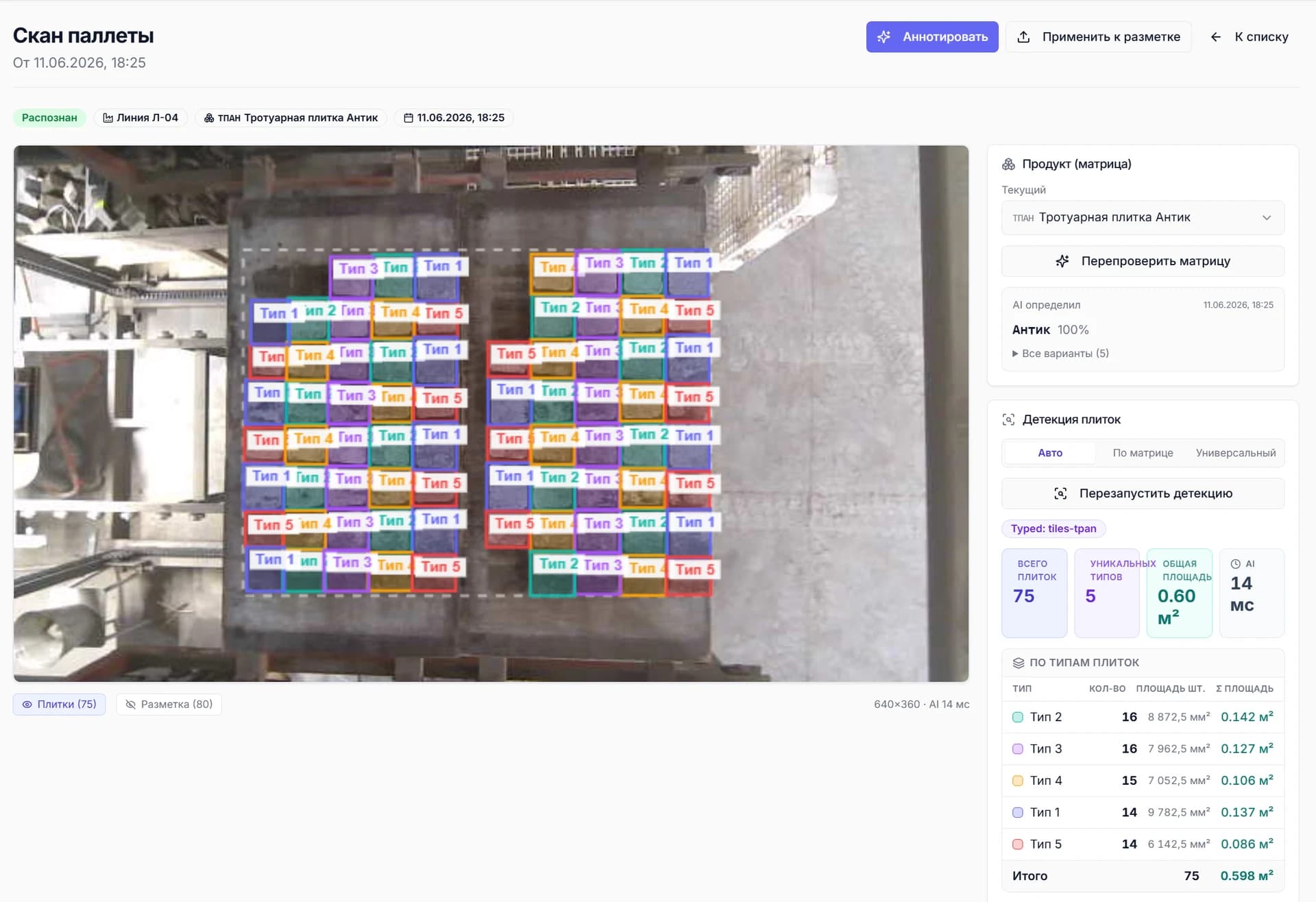
A manufacturing execution system (MES) for production control and output tracking at a paving tile plant. Our own scanners on the lines photograph every pallet, a neural network counts tiles and defects, and planning and analytics update in real time.

200K+pallet scans processed by AI
100%output tracking with no manual input
14 msAI tile detection per scan
4 linesrunning our own scanners
FAQ

Frequently asked questions about ERP systems

Answers to the questions we hear most often

A process map and a prototype of your first ERP module in 3–5 days, free

Map and prototype free · first module from $14,900

Prices are indicative and not a binding offer.

On a 30-minute call we find where the business is losing money and build a clickable prototype of one module: warehouse, production or purchasing. Judge it before any contract or prepayment.

Step 1 of 2 · Task

Keep exploring

Read next

Custom CRMService

Custom CRM

We build a CRM around your sales process: pipelines that match reality, telephony with AI call analysis, two-way sync with your accounting system. A CRM MVP core from $9,900 in 6–10 weeks, a clickable pipeline prototype free in 5 days.

Learn more
IntegrationsService

Integrations

We connect the systems you already run: your ERP or accounting system, CRM, website, phone system and marketplaces exchange data on their own, and managers stop re-typing orders and stock by hand. One integration from $4,900 in 2–3 weeks, a free integration map in 3–5 days. We don't touch your ERP's core.

Learn more
ERP System Cost: Off-the-Shelf vs Custom DevelopmentArticle

Pricing · 16 min

ERP System Cost: Off-the-Shelf vs Custom Development

What an ERP system really costs: off-the-shelf (NetSuite, SAP) vs custom. 3-year TCO, hidden costs, ROI math and a step-by-step selection plan for manufacturing and distribution.

Learn more
How to Choose an ERP System for Your BusinessArticle

Guides · 16 min

How to Choose an ERP System for Your Business

12 criteria for choosing an ERP system for a mid-sized business, from functionality to total cost of ownership. NetSuite, SAP Business One, Odoo and custom development compared.

Learn more