

Updated: October 2026
How much does an AI agent cost in 2026? A pilot on one scenario starts at $3,900 and launches in 2–5 weeks. A production agent integrated with your CRM and knowledge base costs $14,900 to $60K. Support after launch starts at $1,000 a month. Below: what makes up these ranges, what pushes the budget up or down, and which tasks pay back the investment within a few months.
What goes into the price: pilot, product, enterprise
Every agent quote is built from four blocks: scenarios (what it does), data (what it answers from), integrations (where it goes for information and actions) and channels (where it talks to people). Combinations of these blocks give three typical project formats:
| Format | What's included | Range | Timeline |
|---|---|---|---|
| Pilot | 1 scenario, 1 channel, a knowledge base of up to 50 documents, quality metrics, handoff to a human operator | $3,900–$14,900 | 2–5 weeks |
| Product | 3–10 scenarios, integrations with your CRM, ERP and telephony, an admin panel, conversation analytics, several channels | $14,900–$60K | 6–16 weeks |
| Enterprise | Isolated environment, self-hosted models, SLA, several departments and access roles | $30–60K + support | from 3 months |
A pilot answers one question: does the agent work on your task and your data? One scenario, for example, qualifying incoming leads in a messenger. At the end you see numbers: the share of conversations closed without an operator and answer accuracy on a test set. Then you decide whether to expand the project.
A product is an agent built into your processes: it doesn't just answer, it creates deals in the CRM, checks statuses in your ERP and books meetings. This is where an admin panel, an action log and conversation analytics come in, the things that turn a pilot into a working tool for a team.
Enterprise is the top of the product range: an isolated environment, self-hosted models, access policies, several departments. These projects rarely end with a single release; development continues along a roadmap.
If you're not yet sure you need an agent rather than a scripted bot at $1,900, the FAQ at the end of this article explains where the line between them runs.
Price by task: what an agent for a specific function costs
The format sets the range, and the task sets the point within it. Below are benchmarks for the functions clients bring to us most often. All of them fit the three formats in the table above.
| Agent task | Format | Benchmark | What moves the price |
|---|---|---|---|
| Qualifying incoming leads in a messenger or on your website | Pilot | $3,900–$7,500 | number of qualification questions, writing the result to the CRM |
| Answering customers from the knowledge base (first-line support) | Pilot → product | $3,900–$14,900 | size and cleanliness of the knowledge base, number of channels |
| Internal assistant that answers employees' questions about company policies | Pilot | $3,900–$14,900 | number of sources, role-based access |
| AI sales rep: handles conversations and creates deals in the CRM | Product | from $14,900 | CRM and calendar integrations, objection-handling scenarios |
| Analysis of the sales team's calls and chats | Product | from $14,900 | volume of recordings, speech recognition, reports for the sales manager |
| Documents: invoices, contracts, orders → ERP or accounting system | Product | from $14,900 | document types, accuracy requirements, ERP integration |
You can see how this works on a live flow in the AI bot for a property management company in Spain: 256 apartments, with guests writing in from Airbnb, Booking.com, WhatsApp and email. The AI handles 75% of questions without a human, and the median reply time to a guest is under 2 minutes instead of 41. Prices and rules are calculated by ordinary, tested code, and the model only rephrases the ready answer. That's why the agent hasn't made up a single price or rule in all the time it has been running.
What makes a project more expensive
What makes it cheaper
A ready knowledge base. If you already have a structured FAQ, policies in a wiki and current price lists, you skip the most expensive part of the preparation. Projects with a ready knowledge base land at the low end of the range.
One channel and one scenario. The urge to do everything, everywhere, right away is the usual reason quotes balloon. An agent for one task in one channel launches in 2–5 weeks and gives you the numbers to decide whether to expand. Expanding a working pilot is cheaper than building an all-in-one system from scratch.
Systems with a documented API. HubSpot, Pipedrive, Salesforce and modern help desks connect quickly. A homegrown CRM with no documentation is slow and expensive. If you haven't chosen your systems yet, factor this into the decision.
The fastest way to cut the budget is to prepare your data before the project starts: collect the FAQ, clear up contradictions in your policies and assign an owner for the knowledge base. That lowers the quote and shortens the launch.
The economics: when an agent pays off
Let's be conservative and take a typical task: qualifying incoming leads.
The team gets 400 inquiries a month. A manager spends 12 minutes on average on the first pass: clarifying the request, filtering out poor fits, collecting contact details. That's 80 hours a month. The agent handles 70% of these first conversations and passes the manager only qualified leads with a completed record, which saves 56 hours. At a conservative $15 an hour, that's $840 a month, so a $3,900 pilot pays for itself in about 5 months.
The calculation deliberately leaves out two factors that in practice are worth more than the direct time savings. The agent answers at night and on weekends, when leads used to go cold until morning, and it reaches the customer in seconds, not hours. You can plug in your own numbers (lead flow, rates, the share of routine work) in the automation ROI calculator.
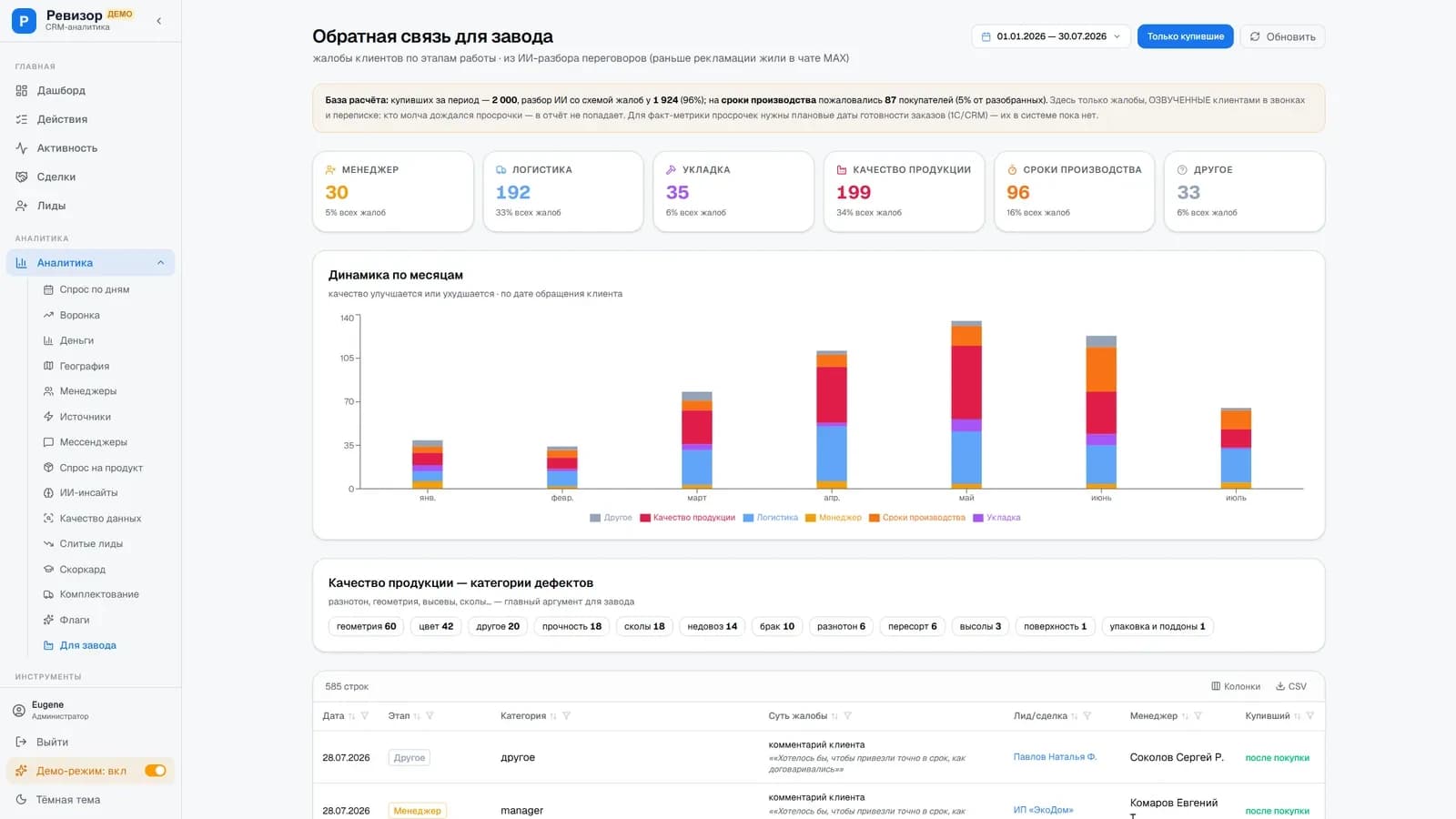
For a live project, see the Revizor case: AI sales and demand analytics on top of Bitrix24, where 100,000+ sales calls went through the AI pipeline.
What an agent costs per month after launch
Development is a one-time payment. After that, the agent has monthly costs, and it's worth including them in the payback calculation from the start rather than learning about them from the first invoice.
| Item | Monthly benchmark | What it depends on |
|---|---|---|
| Support: quality monitoring, knowledge base updates, ongoing adjustments | from $1,000 | number of scenarios and channels |
| Language model requests | usually $0.03–0.80 per conversation | the model, how much of the knowledge base goes into the context, number of messages |
| Server and vector database | $100–300 | knowledge base size, data storage requirements |
| Channels and telephony | provider pricing | WhatsApp Business API, telephony, SMS |
Here's how the model range works out. A conversation is 5–7 messages, and each one carries excerpts from your knowledge base. A lightweight model costs roughly 3 cents for a conversation like that; the most powerful ones, up to tens of cents. At 1,000 conversations a month, that's $30–800. At the $15 an hour from the calculation above, that's anywhere from a couple of hours to about a week of a first-line employee's time.
A note on data. If conversations include customers' personal data, sending it to an external model provider falls under data protection rules (GDPR in the EU) and has to be set up properly. In those projects we use models hosted in the right region under a data processing agreement. If the data can't leave your infrastructure at all, we deploy an open-weight model inside your environment. That changes the model line and may add a GPU server, which is why these projects move to the enterprise format.
How we run a pilot for $3,900
A pilot is a fixed scope of work on a fixed timeline, not “research at your expense”. Here's how it works:
Week 1: scenario and data. We pick one task with a measurable result, assemble the knowledge base (up to 50 documents) and lock in the acceptance metrics: the share of conversations handled without an operator and answer accuracy on a test set.
Weeks 2–3: build. Vector search over the knowledge base (RAG), prompts, topic restrictions, handoff to a live operator. The agent starts answering in a test environment.
Weeks 3–4: runs on real conversations. We run the agent on an export of real inquiries, label the errors and fix the weak topics. This is where quality is decided, not in the choice of model.
Week 5: launch and handover. We connect the live channel, set up monitoring and hand over a dashboard with conversations and metrics. After that: support from $1,000 a month, or a handover to your team.
Important. CRM integrations and multiple channels aren't part of the pilot; they belong to the product stage. What you do get from the pilot is the main thing: numbers on your own data instead of promises from a slide deck.
The scope of work, example tasks and the quote request form are on the service page: AI agent development. We put together a quote for your task within 24 hours; a short call and access to sample inquiries are enough.
FAQ
How much does an AI chatbot cost?
A scripted bot without an AI core starts at $1,900. A bot that understands free-form questions and answers from your knowledge base starts at $3,900: technically, that's already an agent pilot. The line isn't about the label; it's about the ability to handle any wording.
How much does AI agent support cost?
From $1,000 a month. Support covers monitoring answer quality, updating the knowledge base, reviewing difficult conversations and adjusting prompts. Without support, quality degrades: the data goes stale, and new kinds of questions show up that weren't in the tests.
Is there a cheaper option?
If the task is linear (booking, taking a request, order status), a scripted bot from $1,900 handles it, and there's no need to pay extra for AI. A proper agent for less than $3,900 doesn't work out: besides the code, the quote covers data preparation, runs on real conversations and setting up restrictions. Cutting corners on exactly these stages is what produces bots that make up answers.
How much does an agent that works on your own data cost?
Working with your documents through vector search (RAG) is part of the pilot from $3,900, for up to 50 documents from one source. Several sources, regular syncing and large volumes fall into the product range, from $14,900.
What goes into the quote, and why can it be ready in 24 hours?
The quote breaks down into four blocks: scenarios, data, integrations, channels. For each one we have benchmarks from past projects, so after a short call and a look at sample inquiries, the range takes a day to calculate, not two weeks of presales.
How much does an AI agent cost per month?
Support starts at $1,000 a month. On top of that, you pay for the model as you use it: up to 1,000 conversations a month usually costs $30–800, plus $100–300 for the server. We calculate the exact amount in the quote based on your inquiry volume.
How much does an AI sales rep cost?
That's the product format: the agent handles conversations, answers from the price list and creates deals in the CRM. The budget starts at $14,900, and most of it goes into integrations. You can start with a lead qualification pilot from $3,900 and expand based on the results.
Can the agent run on an EU-hosted model or on our own servers?
Yes. EU-hosted models cover most support and lead qualification scenarios. If the data can't leave your infrastructure at all, we deploy an open-weight model inside your environment; that's the enterprise format.
When will we see the first results?
The first metrics come in weeks 2–4 of the pilot, from runs on real conversations. On a conservative estimate, payback takes 4–8 months for tasks with a noticeable share of routine inquiries; a more precise figure comes from your own lead volume and staff rates.