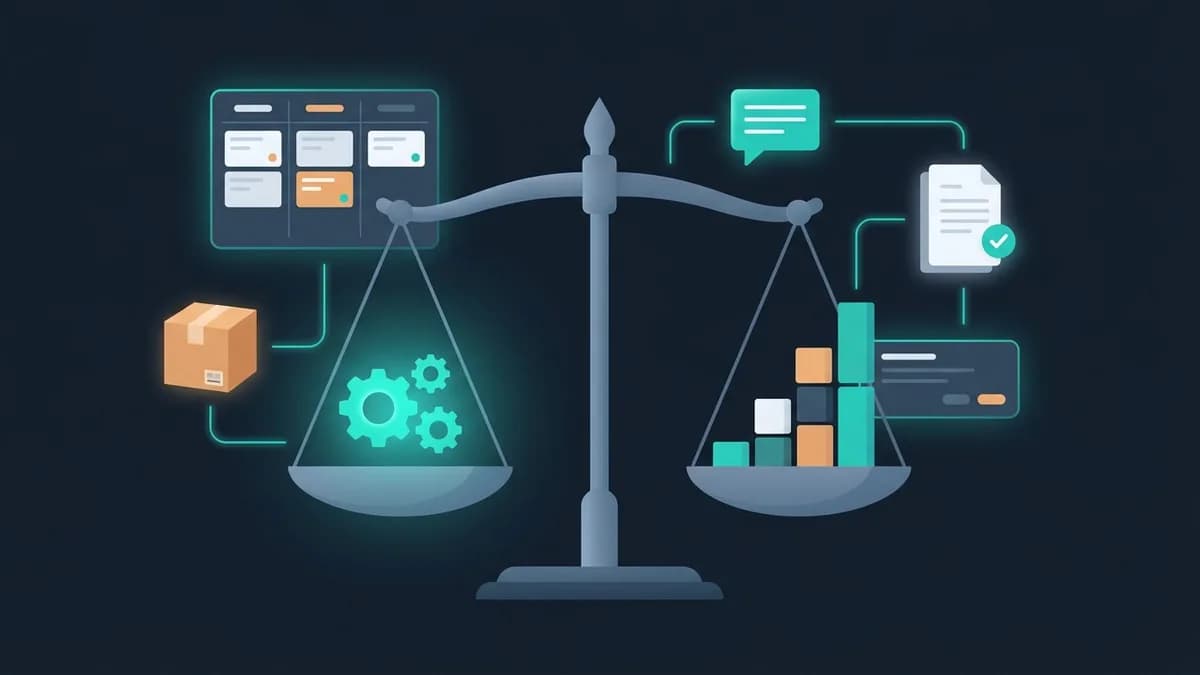
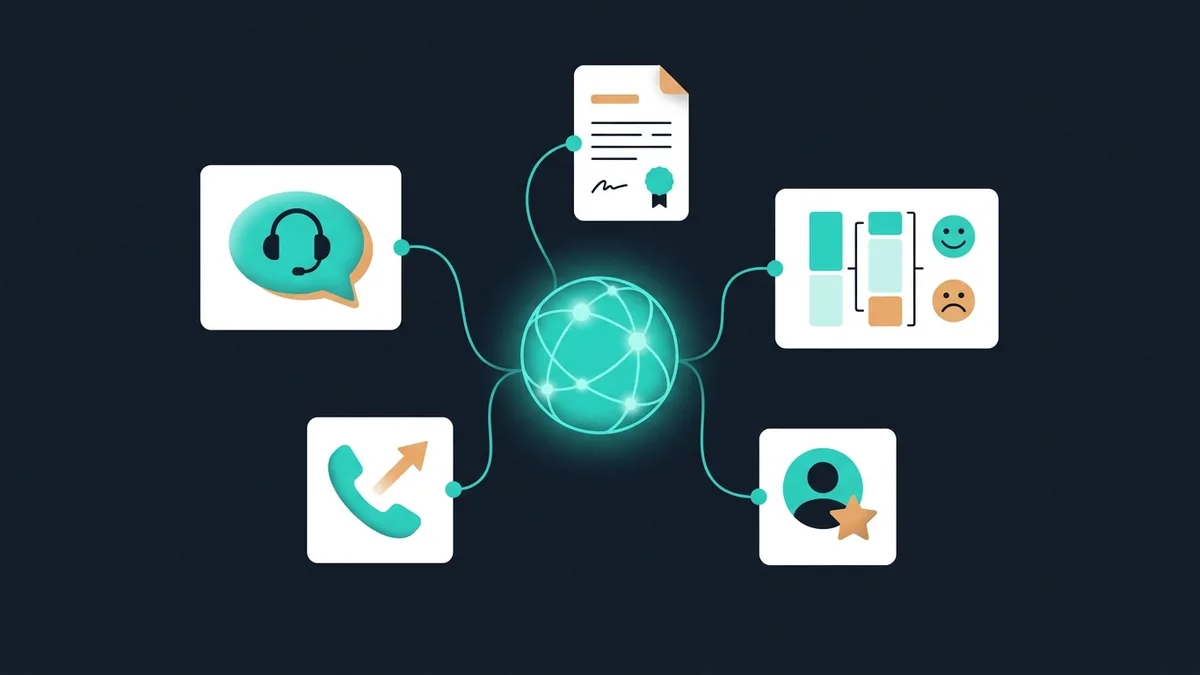

GPT isn't a “trendy toy” or a “threat to jobs.” It's a tool that automates 30–50% of routine text work in a business: answering questions, generating documents, classifying requests, summarizing data. According to McKinsey (2024), companies that adopted generative AI report productivity gains of 20–40% in the processes it touched.
There's a gulf between “trying ChatGPT” and “building GPT into a process.” ChatGPT in a browser is a manual tool. GPT integrated into your CRM or ticketing system is automation. This article covers 5 scenarios we've built for clients: what each one does, what it costs and what ROI it delivers.
How GPT works in a business (without the marketing magic)
GPT (Generative Pre-trained Transformer) is a language model that generates text based on context. In a business, that means it:
Understands natural language. A customer writes “my payment isn't going through,” and GPT understands it's a support request, category “payments,” priority “high.”
Generates text from templates. It uses CRM data to produce a sales proposal, a contract or a report. Not copy-paste, but meaningful text adapted to the context.
Summarizes. A 50-page report → 1 page of key takeaways. 200 customer comments → 5 main themes and their sentiment.
Classifies. An incoming request → an automatic category + priority + an assigned owner. A candidate's resume → a score across 10 criteria.
RAG is the key to accuracy. Out of the box, GPT hallucinates: it makes up facts. For a business that's unacceptable. The fix is RAG (Retrieval-Augmented Generation). The model first searches your knowledge base for relevant information and then generates an answer based on what it found. Accuracy: 85–95% vs 40–60% without RAG. More on AI agents for business.
Scenario 1: Customer support automation
The problem
A SaaS company gets 300+ support requests a day. 60% are routine questions (how to set something up, how to pay, how to integrate). 3 agents work two shifts, the average response time is 47 minutes, and CSAT is 72%.
The solution
An AI bot on GPT-4 + RAG. The knowledge base: 500 Help Center articles + 10,000 past tickets (anonymized). The bot answers routine questions instantly. Complex ones it escalates to an agent with context (a summary of the request + a suggested solution).
The result
The bot closes 67% of requests with no human involved. Average response time: from 47 minutes to 30 seconds (bot) / 15 minutes (agent, who gets the context from the bot). CSAT rose to 84%. Savings: one full-time support agent.
Cost and ROI
Development: $12,000–17,000. Servers + OpenAI API: around $1,000–1,700/month. Payback: 6–8 months. First-year ROI: 150–200%.
Scenario 2: Generating sales documents
The problem
Sales reps spend 40–60 minutes preparing a proposal: they copy a template into Word, fill in the client's details, pick relevant case studies and calculate the price. At 5 proposals a day, that's 3–5 hours of manual work.
The solution
A GPT integration with the CRM. The rep clicks “Generate proposal” in the deal card. The system pulls the client's data (industry, size, needs), the correspondence history, relevant case studies from the database and the price list. GPT generates a personalized proposal as a PDF: a description of the solution, matching case studies, the price calculation and the terms. The rep reviews it and sends it.
The result
Time to prepare a proposal: from 40–60 minutes to 5–10 minutes (review + edits). Proposals per day: from 5 to 12–15. The proposal-to-deal conversion rate rose by 15% thanks to personalization: GPT picks case studies from the client's own industry.
Cost and ROI
Development: $7,000–12,000. API: around $300–700/month. Payback: 2–4 months (more sales + time saved for the sales team).
Scenario 3: Analyzing reviews and customer feedback
The problem
An e-commerce company gets 500+ reviews a month (its website, marketplaces, social media). A marketer reads them by hand, categorizes them and picks out the problems. It takes 20–30 hours a month, and the analysis is subjective and incomplete.
The solution
A GPT pipeline: automatic review collection (marketplace APIs + scraping), classification (product / delivery / service / price), sentiment detection (positive / neutral / negative), extraction of key problems and a weekly digest for management.
The result
Analysis time: from 20–30 hours to zero (it's automatic). It surfaced patterns the marketer hadn't noticed: 23% of negative reviews were about the packaging, not the product. After the packaging was fixed, the rating rose from 4.2 to 4.6.
Cost and ROI
Development: $5,000–8,500. API: around $150–500/month. Payback: 3–4 months (the marketer's time saved + a higher rating → more sales).
Scenario 4: An AI sales assistant
The problem
Sales reps spend a long time preparing for calls: they study the client's website and interaction history and look for relevant case studies. New reps don't know the product well and flounder on objections.
The solution
An AI assistant in the CRM. Before a call it generates a client “dossier” (data from the website, the CRM and LinkedIn), suggests a call script and prompts answers to typical objections. During the call it transcribes the conversation (Whisper API) and highlights key moments; after the call it drafts a follow-up email.
The result
Call prep time: from 15 minutes to 2 minutes. Call-to-deal conversion: +22% thanks to better preparation. Onboarding of new reps: from 3 months to 3 weeks (the AI assistant acts as a “virtual mentor”).
Cost and ROI
Development: $13,000–20,000. API (GPT + Whisper): around $700–1,300/month. Payback: 3–5 months (higher conversion × average deal size).
Scenario 5: HR process automation
The problem
The HR team handles 200+ resumes a month. Screening one resume takes 5–10 minutes. Answering candidates' routine questions (salary, schedule, benefits) eats 30% of a recruiter's time. Onboarding involves 10+ documents that have to be explained to each new hire.
The solution
Resume screening: GPT analyzes a resume, matches it against the job requirements, assigns a score (0–100) and highlights strengths and red flags. The recruiter only looks at candidates scoring 70+.
A chatbot for candidates: answers routine questions (schedule, salary range, hiring stages, office), books interviews and collects basic information.
An onboarding bot: answers a new hire's questions during their first 30 days. “Where's the vacation policy?” The bot sends a link and a summary of the document. “How do I take sick leave?” A step-by-step guide.
The result
Screening time: from 15–30 hours a month to 3–5 hours. Recruiter time spent on routine questions: −60%. Onboarding satisfaction (NPS): from 45 to 72.
Cost and ROI
Development: $8,500–13,000. API: around $300–800/month. Payback: 4–6 months (HR time saved + lower turnover thanks to better onboarding).
The pitfalls of implementing GPT
Hallucinations. GPT confidently generates facts that don't exist. The fix: RAG (answers based on your knowledge base) + verification (a person checks critical answers). For customer support, a fallback to a human agent when confidence is low.
Data security. When you send data to the OpenAI API, it goes to someone else's servers. The fix: the OpenAI API (not ChatGPT) doesn't use your data to train the model (with that option turned off in the settings). For sensitive data: self-hosted models (Llama 3, Mistral), where everything stays on your servers; infrastructure starts at around $1,000/month.
API costs. GPT-4 Turbo: ~$10–30 per 1 million tokens. At 1,000 requests a day, that's around $500–1,700/month. GPT-4o-mini is 10 times cheaper and good enough for 80% of tasks. Work out the unit economics before you build. More on the math in neural networks for business.
Expecting miracles. GPT won't replace an expert. It automates routine work: answers to common questions, document drafts, classification. Complex decisions (strategy, negotiations, creative work) still belong to people.
1) Pick one process with the most routine work (customer support, document generation). 2) Gather the data: FAQs, templates, ticket history. 3) Build a prototype in 2–4 weeks (API + a simple interface). 4) Test it on real tasks for 2 weeks. 5) Measure the ROI and scale. Start by automating one process, not with an “AI transformation of the whole company.”
FAQ: common questions about GPT in business
How much does it cost to build GPT into a business process?
MVP: from $3,900 (1 process, 2–4 weeks). Mid-sized project: $12–20K (2–3 processes, CRM/ERP integration, 1–2 months). Complex: from $20K to $35K (an AI platform for several departments, a self-hosted model). Monthly: API $150–1,700, infrastructure $150–1,000.
GPT-4 or open-source models (Llama, Mistral)?
GPT-4 / Claude: the best quality and an easy start (API), but your data goes to someone else's servers. Open-source (Llama 3, Mistral): your data stays with you and there are no API fees, but you need infrastructure (a GPU server from around $1,000/month) and ML expertise. For an MVP, start with the GPT-4 API; consider open-source when you scale.
Is it safe to send company data to OpenAI?
The OpenAI API (not ChatGPT) doesn't use your data for training (you can turn this off in the settings). But the data does go to OpenAI's servers, which may be unacceptable for confidential financial data or personal data covered by GDPR. The fix: self-hosted models or Azure OpenAI (the data stays in your Azure tenant).
Will GPT replace employees?
It won't replace them, but it changes their roles. A support agent becomes an agent who handles complex cases (the bot closes the simple ones). A sales rep becomes a rep with an AI assistant that drafts the materials, dossiers and follow-ups. Less routine, more expert work.
How quickly does it pay off?
Customer support: 4–8 months. Document generation: 2–4 months. Review analytics: 3–4 months. AI sales assistant: 3–5 months. HR automation: 4–6 months. The market median: 3–6 months for a typical scenario.
Can we implement GPT without developers?
Partly. Zapier + the OpenAI API works for simple pipelines (incoming email → classification → reply). Make (formerly Integromat) handles more complex scenarios. But for CRM integration, custom RAG and production-grade quality, you need developers.