

Updated: October 2026
DevOps implementation cost in 2026: a basic setup (CI/CD, Docker, monitoring) runs $4.9K–10K over 2–4 weeks, an advanced setup with IaC and logging $10–20K, and enterprise with Kubernetes $20–55K. The minimum start for a single project is $2,700–6,000 over four weeks. Below: what each level includes and when the investment pays off.
DevOps is one of the most confusing words for a business. Developers say “we need DevOps,” and the CEO hears “we need another expensive specialist who does something nobody understands.” In reality, DevOps is a set of practices that speeds up releases, cuts the number of outages and automates manual work. Companies with mature DevOps practices deploy 200 times more often and recover from failures 2,600 times faster (DORA State of DevOps Report 2024).
In money terms: if your website is down 4 hours a month, you lose 4 hours of revenue. If shipping a new feature takes 2 weeks instead of 2 hours, competitors get ahead of you. If a developer spends 2 hours a week on manual deployments, that's 100+ hours a year paid out of your budget. DevOps solves all three problems.
What DevOps is, in plain terms
DevOps = Development + Operations. Without DevOps, the process looks like this: a developer writes code → hands it to a sysadmin → the sysadmin figures out how to run it → something doesn't work → the task bounces back and forth → 2 weeks later the update reaches production.
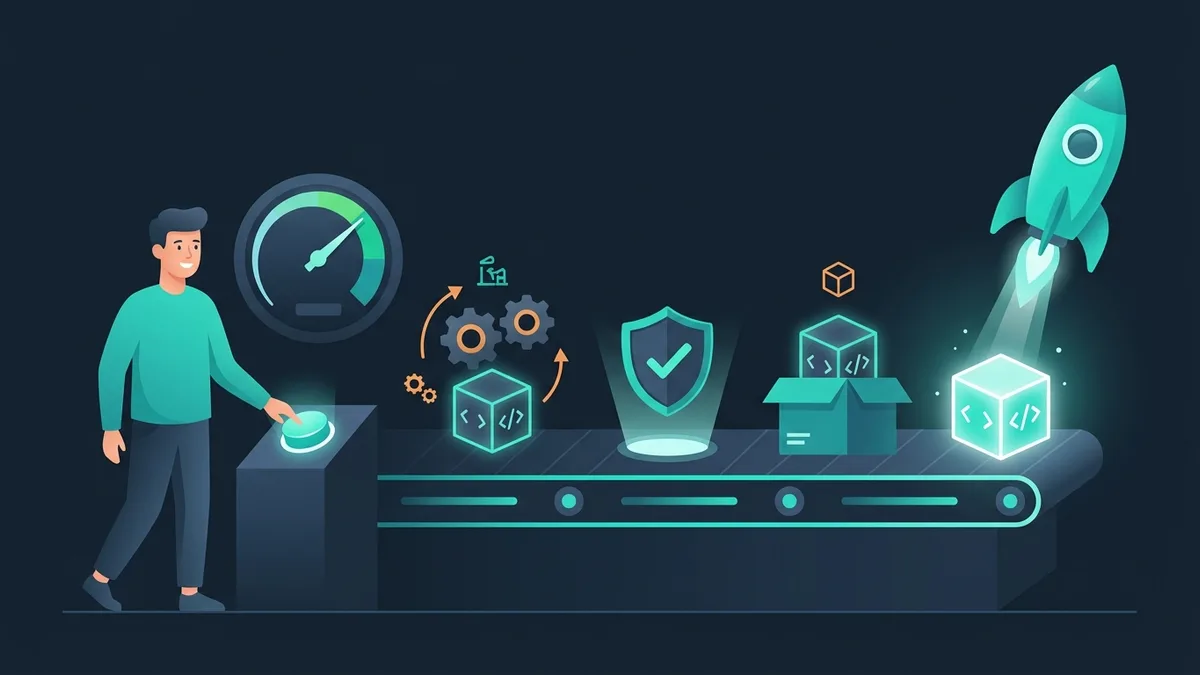
With DevOps: a developer pushes code to Git → tests run automatically → if they pass, the code is deployed to staging automatically → QA checks it → one button, and the update is in production. The whole process takes 10 minutes to 2 hours.
DevOps isn't one person. It's a set of practices and tools:
A business analogy. DevOps is like an assembly line in a factory. Without the line, a craftsman builds every part by hand: slow, error-prone, and everything depends on that one person. With the line: automated assembly, quality control at every stage, 10x the speed, and the craftsman supervises the process instead of turning bolts.
Why a business needs DevOps: 5 concrete benefits
1. Faster time-to-market
Without CI/CD: a release every 2–4 weeks (manual build, testing, deployment). With CI/CD: several releases a day. For the business, that means you react to the market faster, test hypotheses faster and fix bugs faster. A competitor ships a feature in a day, you take a month. Who wins?
2. Less downtime
A small business without monitoring averages 2–8 hours of downtime a month. For an online store doing $180,000 a month, an hour of downtime costs about $250 ($180,000 / 720 hours). 4 hours of downtime = $1,000. Monitoring detects a problem within 1–3 minutes. Automatic restarts fix 70% of problems without anyone stepping in. Downtime drops by 60–90%.
3. Developer time saved
A manual deployment takes 30–60 minutes (connect to the server, upload files, restart, check). With 2–3 deployments a week, that's 3–6 hours a week. An automated deployment takes 5–10 minutes (push to Git, and CI/CD does the rest). Savings: 2–5 hours a week × 50 weeks = 100–250 hours a year × roughly $60 an hour = $6,000–15,000 a year.
4. Stability and predictability
DevOps takes the human factor out of routine operations. A script won't forget to update a config. A pipeline won't skip the tests. Monitoring won't sleep through an outage. The result: fewer fire drills, less stress, predictable timelines.
5. Security
DevSecOps is DevOps with a focus on security. Automated vulnerability scanning of dependencies (Snyk, Trivy), automatic security updates, secrets stored in a vault rather than in the code. Without DevOps, a developer keeps the database password in a .env file on their laptop.
DevOps implementation cost
Basic DevOps ($4.9K–10K, 2–4 weeks). A CI/CD pipeline (GitLab CI / GitHub Actions), Docker containers for the application, basic monitoring (Uptime Kuma + Grafana), automated deployment to staging and production. A fit for: 1–2 projects, a team of 2–5 developers, one server.
Advanced DevOps ($10–20K, 1–2 months). Everything in basic plus Infrastructure as Code (Terraform), centralized logging (ELK / Grafana Loki), backups with automated verification, a staging environment (a full copy of production), security scanning (dependencies, Docker images), alerting (Slack, PagerDuty). A fit for: 3–5 projects, a team of 5–15 developers, several servers.
Enterprise DevOps ($20–55K, 2–4 months). Everything in advanced plus Kubernetes (container orchestration), high availability (fault tolerance, zero-downtime deployments), GitOps (ArgoCD), a service mesh (Istio), FinOps (cloud cost optimization). A fit for: a microservice architecture, 10+ developers, strict availability requirements (99.9%+).
Summary of implementation stages with budgets and timelines:
| Stage | What's included | Budget | Timeline |
|---|---|---|---|
| Containerization | Docker images, the same environment everywhere | $700–1,700 | 1 week |
| CI/CD | Automated builds, tests, deployment (GitLab CI / GitHub Actions) | $1,000–2,300 | 1 week |
| Monitoring | Uptime Kuma, Sentry, a Grafana dashboard, alerts | $700–1,300 | 1 week |
| Backups | Automated database and file backups, restore checks | $300–700 | 1 week |
| Basic package | CI/CD + Docker + monitoring working together | $4.9K–10K | 2–4 weeks |
| Advanced | + IaC (Terraform), logging, staging, security scanning | $10–20K | 1–2 months |
| Enterprise | + Kubernetes, high availability, GitOps | $20–55K | 2–4 months |
In 80% of cases, no. Docker + docker-compose on a VPS covers the needs of a business with 1–5 projects and up to 50K users. You need Kubernetes when you have 10+ microservices, autoscaling (load swings by 10x or more), a 99.99% uptime requirement or a team of 10+ developers. Kubernetes without a reason = +$3,000–7,000 for infrastructure and a DevOps engineer at $10,000/month.
DevOps tools we use
CI/CD
GitLab CI is our main choice. It's built into GitLab (Git hosting + CI/CD in one place), has powerful pipelines and is free when self-hosted. GitHub Actions if your code lives on GitHub; free minutes for open source. Jenkins is legacy but still popular in enterprise.
Containerization
Docker is the standard. Docker Compose for local development and simple deployments (1–5 containers). Kubernetes for complex deployments (10+ containers, autoscaling). Docker Swarm is a simplified alternative to Kubernetes (easier, but less capable).
Monitoring
Prometheus + Grafana is the open-source standard. Prometheus collects metrics, Grafana visualizes them. Free, powerful, a huge community. Uptime Kuma is simple availability monitoring (ping, HTTP, TCP). Free and self-hosted. Sentry monitors application errors (stack traces, context, alerts). The free plan covers up to 5K errors a month.
Logging
Grafana Loki + Promtail is a lightweight alternative to ELK. It uses fewer resources and integrates with Grafana. ELK (Elasticsearch + Logstash + Kibana) is the enterprise standard, but resource-hungry (8GB of RAM at minimum). Loki for a small business, ELK for enterprise.
IaC
Terraform manages infrastructure (servers, networks, DNS, databases). It supports AWS, Google Cloud, Azure, DigitalOcean, Hetzner and more. Ansible configures servers (installing software, setting up files). They're often used together: Terraform creates the servers, Ansible configures them.
DevOps for a small business: where to start
You don't have to implement everything at once. Here's the order of priority:
Total: basic DevOps in 4 weeks for $2,700–6,000. After that, add pieces as you grow: logging, IaC, a staging environment, security scanning.
DevOps engineer: hire or outsource
An in-house DevOps engineer (the alternative is outsourced DevOps): from about $10,000/month with taxes, depending on seniority and location. Makes sense with 5+ projects, a team of 10+ developers and your own infrastructure (servers, Kubernetes). Pro: deep knowledge of your infrastructure, an instant response to incidents.
Outsourced DevOps: $1,500–5,000 a month for ongoing support, or $4.9K–20K for a one-off implementation project. Makes sense with 1–3 projects, a small team and cloud infrastructure. Pro: cheaper than a full-time hire, access to expertise. Con: the response isn't always instant.
DevOps isn't an expense, it's an investment. Every dollar put into infrastructure automation comes back 3–5 times over: through developer time saved, less downtime and faster releases. The question isn't “why do we need DevOps” but “how much are we losing without it.”
FAQ
How much does DevOps implementation cost?
A basic package (CI/CD, Docker, monitoring) costs $4.9K–10K and takes 2–4 weeks. An advanced level with Terraform, logging and a staging environment costs $10–20K over 1–2 months. Enterprise with Kubernetes and high availability costs $20–55K. The minimum start for a small team is $2,700–6,000 over four weeks.
What makes up the cost of DevOps?
Four lines of work: CI/CD setup ($1,000–2,300), containerizing the application ($700–1,700), monitoring and alerting ($700–1,300), backups with restore checks ($300–700). On top of that come optional levels: Infrastructure as Code, centralized logging, Kubernetes. The tools themselves are open source and free: you pay for the engineers' work and the servers (about $30–150 a month).
Does a small company with one project need DevOps?
The basic level, yes. Docker + CI/CD + monitoring cost $2,700–6,000 and save 100–250 hours a year. Kubernetes and IaC, no: they're for a bigger scale. Even for a single project, automated deployment and monitoring are a must-have.
How much does DevOps cost per month?
Tools (Prometheus, Grafana, GitLab CI, Docker): free (open source). Servers for the infrastructure (monitoring, logging): about $30–150 a month. An in-house engineer: from about $10,000/month. Outsourcing: $1,500–5,000 a month. For a small business: $0–150 a month (once a contractor has set everything up and it runs).
How is DevOps different from a system administrator?
A sysadmin configures servers by hand and works reactively (something breaks → we fix it). DevOps automates everything and works proactively (monitoring warns you before something breaks), with Infrastructure as Code (servers are described in code, not configured by hand). A DevOps engineer is a sysadmin who writes code.
How do I measure the impact of DevOps?
The 4 DORA metrics: 1) Deployment frequency (before and after). 2) Lead time (from commit to production). 3) MTTR (time to recover from a failure). 4) Change failure rate (the share of deployments that cause an incident). Measure before implementation, then again 3 months later, and you'll see the difference.