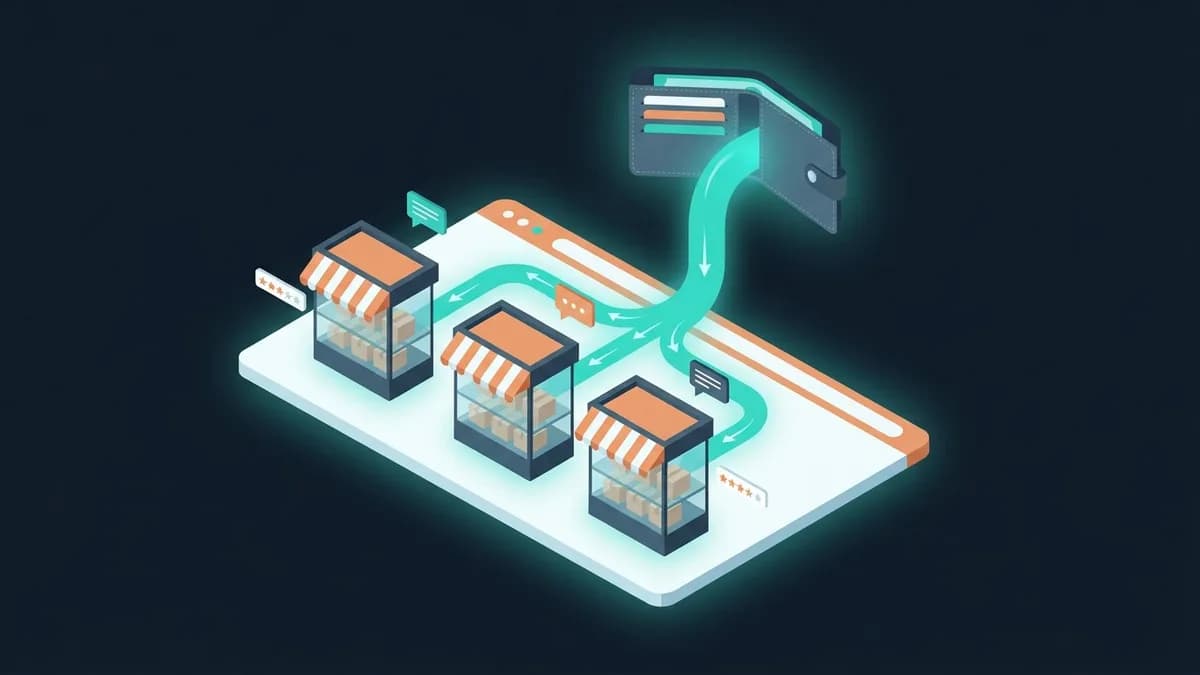


A marketplace is an attractive business model and a hard one. Attractive because at scale the margins are huge: Amazon doesn't buy what third-party sellers list, it takes a referral fee (15% in most categories). Hard because you have to attract sellers and buyers at the same time, and neither side wants to be first on an empty platform.
And the opportunity isn't limited to Amazon and eBay. Niche marketplaces (B2B platforms, service marketplaces, vertical marketplaces) are a growing trend. This article is practice, not theory: how to get from an idea to your first sales without spending a fortune on something the market doesn't need.
Step 1: Choose a niche and a business model
Types of marketplaces
B2C (seller → buyer). Amazon, eBay, Walmart Marketplace. A mass market with heavy competition from giants. Your chance is a narrow niche: farm products, handmade goods, used electronics, local craftspeople.
B2B (business → business). Rolled metal, building materials, industrial equipment. Less competition, much higher order values (from a few thousand to hundreds of thousands of dollars), more complex processes (tenders, payment terms, logistics). Examples: Alibaba, Amazon Business.
C2C (user → user). Facebook Marketplace, Craigslist, OfferUp. The platform is the middleman. Monetization: promoted listings, verification, secure checkout.
Service marketplaces. Thumbtack, TaskRabbit, Upwork. Services instead of goods: repairs, cleaning, freelance work, consulting. What's specific: ratings, portfolios, an availability calendar.
How the marketplace makes money
Commission per transaction is the main model: 5–25% of the deal value. Amazon: 15% in most categories, Etsy: 6.5% per sale, Airbnb: 3–15%. Pro: it scales with volume. Con: no volume, no revenue.
Seller subscription. A fixed monthly fee for being on the platform, typically tens to hundreds of dollars a month (Amazon's Professional selling plan is $39.99). Pro: predictable revenue. Con: a barrier for new sellers, who have to pay for an unproven platform.
Listing fees. A fee for posting a listing (classifieds sites, job boards). Pro: revenue from day one. Con: the seller pays whether or not anything sells, and that erodes trust.
Freemium. Basic features are free, advanced ones are paid. Pro: the largest possible user base. Con: low conversion to paying users (2–5%).
Advice on choosing a niche. Don't try to compete with Amazon on “everything for everyone.” Look for vertical niches with real pain: B2B purchasing (a complicated process you can simplify), local markets (farmers + city residents), expert services (therapy, legal, medical). More on the architecture in our article on building a marketplace from scratch.
Step 2: Solve the chicken-and-egg problem
The core problem of every marketplace: buyers won't come without sellers, and sellers won't come without buyers. Here are strategies that work:
Step 3: The MVP and what to build first
Must-have MVP features
For sellers: sign-up and profile, product or service listings (name, description, price, photos), order management (incoming, confirm, decline), basic analytics (views, orders, revenue).
For buyers: a catalog with search and filters, a product page with photos and a description, a cart and checkout, payment (cards and digital wallets), a profile with order history.
For the platform: an admin panel (moderation, users, finances), ratings and reviews, notifications (email + push), basic analytics (GMV, number of orders, conversion).
What you DON'T need in the MVP
A mobile app (a responsive website is enough), chat between seller and buyer (use email or messaging apps at first), AI recommendations (wait until you have 1,000+ products), a loyalty program (wait until you have 1,000+ buyers), multiple currencies or languages.
Step 4: Tech stack and architecture
Frontend: Next.js (React) with SSR for SEO (the catalog has to be indexed), TypeScript, Tailwind CSS. SEO is critical for a marketplace: 40–60% of traffic comes from search.
Backend: Node.js (NestJS) or Python (Django). NestJS: a strict architecture, WebSocket for chat (when you add it), TypeScript. Django: an ORM, an admin panel out of the box, a fast start. More on choosing a stack in our guide to choosing technologies.
Database: PostgreSQL (primary) + Redis (catalog cache, sessions) + Elasticsearch (full-text catalog search, a must once you pass 1,000 products).
Payments: split payments through Stripe Connect or PayPal (the buyer's money comes in, your commission is held back, the rest goes to the seller). This is critical: you need split payments, not ordinary payment processing. Stripe Connect and PayPal's marketplace solution both support splits.
Infrastructure: Docker + a VPS (Hetzner, DigitalOcean). Kubernetes once you reach 100K+ users. At the start, a VPS for well under $100 a month is enough.
A marketplace is thousands of pages (product pages, categories, filters). Every page is a potential entry point from search. Next.js with SSR renders HTML on the server, so search crawlers see the content. Add unique titles and descriptions for every product page, structured data (Product, Offer, Review) and an XML sitemap covering all pages.
Cost and timeline
MVP ($22.9K–$35K, 3–5 months). Catalog, search, cart, payments (split), seller and buyer profiles, admin panel, ratings. Enough to launch in one niche with 30–50 sellers.
Full version ($35–90K, 5–8 months). The MVP plus chat, advanced analytics, promo codes, subscriptions, shipping integrations (UPS, FedEx, DHL), an API for sellers (bulk product upload), AI-assisted moderation.
Enterprise ($60–150K, 8–12 months). The full version plus a mobile app (Flutter), AI recommendations, B2B features (tenders, payment terms), marketplace-as-a-service (white-label for franchises). More on development in our article on building a marketplace from scratch.
Step 5: Win your first sellers
Direct sales. The main channel at the start. A list of 50–100 potential sellers, phone calls, and an offer: 0% commission for 3 months, help with content (photos, descriptions), promotion on the platform (featured placement, a banner).
Content marketing. A blog, a YouTube channel, a newsletter about your niche. Bring in experts from among your potential sellers: they'll become your first users.
Aggregating existing content. Scraping catalogs, open databases and classifieds sites. Legally risky for products (you need the seller's consent), safe for open data (ratings, reviews, directories).
Referral programs. A seller invites another seller and both get a bonus (a commission discount, a free promotion period).
Step 6: Win buyers
SEO. A long-term strategy, but the cheapest per click. Optimize product pages, build landing pages for categories, earn backlinks. Results come in 3–6 months, but the traffic is free and keeps growing.
Paid search. Google Ads for fast traffic. Important: track CAC (customer acquisition cost) and compare it with LTV. A marketplace can only afford a low CAC per buyer: it has to be paid back by your commission on that buyer's orders.
Content. Reviews, comparisons and guides for your niche. “How to choose [product category]” → article → traffic → conversion. Works well for complex niches (B2B, expert services).
Referral program. “Invite a friend, get $10 off your first order.” Uber, Airbnb and every successful marketplace use referrals. Cost: about $10–15 per new buyer, cheaper than ads.
7 mistakes when launching a marketplace
1. Building the full platform right away ($60–150K). Spending a year building the perfect product, then finding out the market doesn't need it. An MVP from $22,900 → test the hypothesis → iterate.
2. Ignoring one side. Great UX for buyers, a clunky interface for sellers. Sellers leave → there are no products → buyers leave. Keep the balance.
3. Too broad a niche. “A marketplace for everything and everyone” fails. Start narrow: one city, one category, one segment. Expand once you've gained a foothold.
4. No split payments. Taking payments into your own account and paying sellers by hand is a legal and operational nightmare. Use split payments from day one.
5. No moderation. Without moderation, the catalog fills up with low-quality content: bad photos, inaccurate descriptions, duplicates. Buyers lose trust. Moderation (manual or AI) is a must.
6. Ignoring the legal side. A marketplace is an agent, not a seller. You need terms for sellers, terms for buyers, a return policy, compliance with the sales tax and receipt rules in your market, and with data protection rules such as GDPR. A lawyer's consultation costs far less than the fines it helps you avoid.
7. Launching without unit economics. A 5% commission on a $30 average order = $1.50 per order. Buyer CAC is $18. You need 12 repeat orders to break even. If the average buyer places 3 orders, the model doesn't work. Do the math before development.
FAQ: launching a marketplace
How much does it cost to launch a marketplace?
MVP: $22.9K–$35K (3–5 months). Full version: $35–90K (5–8 months). Plus marketing at the start: $3,000–10,000 a month. Total budget before the first sales: roughly $40–100K.
Can I use an off-the-shelf platform (Sharetribe, CS-Cart)?
To validate the idea, yes. Sharetribe: from $99/month, minimal features, a fast launch. CS-Cart Multi-Vendor: a one-time license, more features. But as you scale, off-the-shelf solutions hold you back: customization is expensive, performance is limited, and you're locked into the vendor.
How do I solve the chicken-and-egg problem?
5 strategies: start with one side (sellers or buyers), become a seller yourself, limit the geography, work by hand, and deliver value without the marketplace (a SaaS tool, content).
What commission is optimal?
It depends on the niche: goods 5–15%, services 10–25%, B2B 1–5% (but with bigger orders). Start at 0% for your first sellers and raise it gradually. The test: your commission has to be lower than what the seller's alternative costs (their own website + marketing).
Do I need a mobile app?
Not at the start. A responsive website covers 90% of needs. Build an app when DAU (daily active users) passes 5–10K and you need push notifications, offline access or a native UX. A mobile app (Flutter) costs from $16,900 on top.
How do I get my first 50 sellers?
Direct sales (cold calls, in-person visits). Offer 0% commission for 3 months, help with content and marketing support. Cold outreach converts at 5–15%. You'll need 300–1,000 contacts to land 50 sellers.
How many sellers do I need to launch?
It depends on the niche. A product marketplace: 30–50 sellers (so the catalog doesn't look empty). A service marketplace: 10–20 specialists. B2B: 5–10 suppliers (but with deep catalogs). The rule: a buyer should find what they're looking for on the first visit.