
Every week founders come to us with a “brilliant app idea.” Half of them never launch after a month of discussions and Figma prototypes. Those who do launch often spend $35–90K on a product the market doesn't need. According to CB Insights, 42% of startups shut down because there was no demand.
An MVP (Minimum Viable Product) is a way to test an idea with real money, not with pitch decks and business plans. Instead of spending a year building the “perfect product,” you launch a minimal version in 3–6 weeks and see whether people are willing to pay for it. This article gets specific: what an MVP is (and what it is NOT), 5 steps from idea to launch, what it costs, and which mistakes are guaranteed to kill your project.
What an MVP is and how it differs from a prototype
Muddled terms kill projects. Let's pin them down.
A prototype is a mockup: clickable screens in Figma you can “walk through.” A prototype shows what the product will look like. But it doesn't work: no backend, no data, no real users. A prototype answers the question “Is the interface clear?”
An MVP is a working product with minimal functionality. Real users sign up, pay and use it. Yes, it's rough, it has limits, and it lacks 80% of the “must-have” features. But it's real. An MVP answers the question “Are people willing to pay for this?”
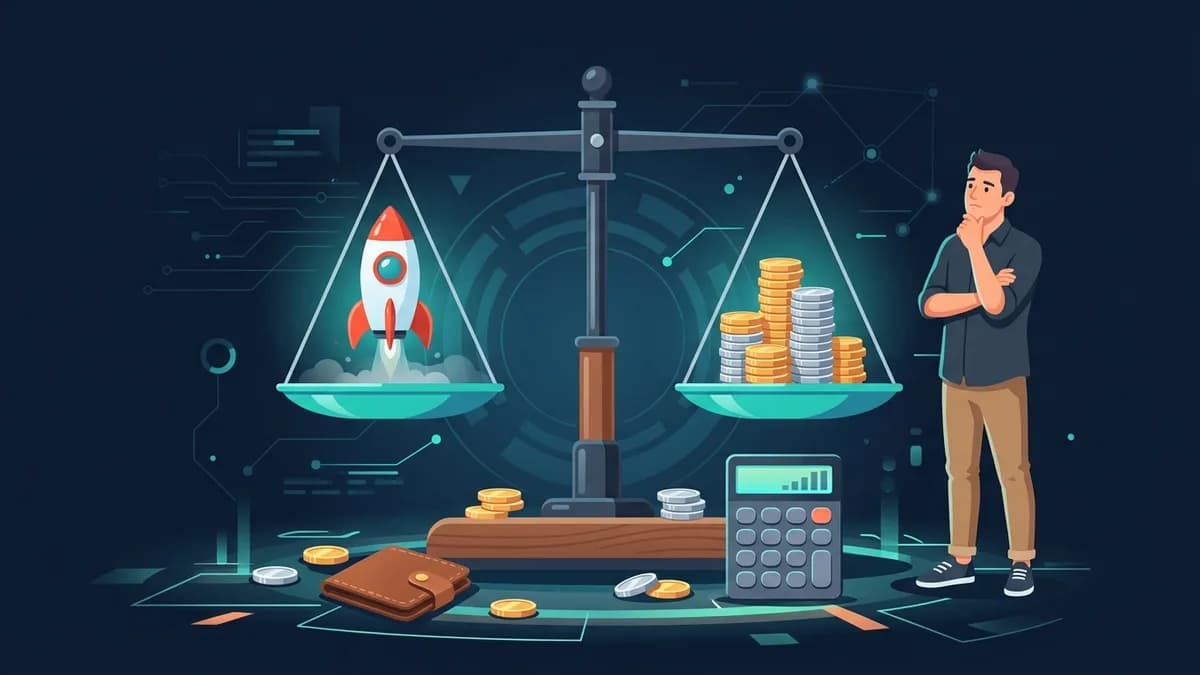
The difference is critical. A prototype costs $1,000–2,500 and tells you about usability. An MVP starts at $9,900 and tells you about the market. 100 people saying “great idea, we'd use it” means nothing. 10 people paying money is validation.
5 steps from idea to launch
Step 1: Define one problem (3 days)
Not “make people's lives better,” not “build a platform for everything.” One specific problem for one specific audience.
Bad: “A fitness app with workouts, nutrition, sleep, meditation and a social network for athletes.”
Good: “A home workout app that generates a program based on the equipment and free time you have.”
The formula: [Who] wants to [do what] because [pain], and existing solutions [don't meet the need].
Example: “A yoga studio owner wants to manage the schedule and bookings automatically, because 3 hours a day go into WhatsApp messages, and CRM systems are too complex and expensive for a studio with 3 instructors.”
Run 5–10 interviews with potential users. Don't ask “do you like the idea?” (they'll always say yes). Ask “how do you solve this problem today? how much time or money does it take? what drives you crazy?” If people don't have the problem, you don't need to build an MVP.
Step 2: Define one success metric (1 day)
An MVP is an experiment. An experiment needs a hypothesis and a success criterion.
Examples:
“If 50 of 500 sign-ups pay for a subscription in the first month (10% conversion), the hypothesis is confirmed and we scale.”
“If week-2 retention is above 30%, the product solves a real problem.”
“If NPS is above 40 after the first week of use, users are ready to recommend it.”
One metric. Not three. Not five. One: the one that tells you whether to keep going.
Step 3: Cut 80% of the features (2 days)
The most painful step. The founder sees a product with 30 features. The MVP should have 3–5. The rest go into “later” (if later ever comes).
The MoSCoW method:
If you are not embarrassed by the first version of your product, you've launched too late. Reid Hoffman, founder of LinkedIn.
Step 4: Development (2–4 weeks)
Technical choices that speed up an MVP:
Cross-platform development. Flutter or React Native instead of native iOS + Android. One codebase saves 30–40% of the budget and time. It's the best fit for an MVP.
Ready-made components. Sign-in via Firebase Auth, payments via Stripe or PayPal, push notifications via FCM. Don't write your own; use what already exists.
BaaS (Backend as a Service). Supabase and Firebase let you launch a backend without building one. For simple MVPs that saves 30–50% of the budget.
Minimal design. UI kits (Material Design, Cupertino) instead of custom design from scratch. For an MVP, functionality matters more than a unique visual style. You'll refine the design once demand is confirmed. The exception is products where design is the value (dating, lifestyle, fashion): there, visuals shape the first impression and retention.
A good requirements spec saves 20–30% of the development budget. We covered how to structure one, with examples, in a separate article.
Step 5: Launch and measure (1 week)
Don't wait for the “perfect moment.” Launch when the Must Haves work reliably.
Channels for your first users:
Niche communities (Slack and Discord groups, subreddits, Telegram channels) are the best free channel for B2B and niche products. Product Hunt works well for SaaS and developer tools. Direct invitations to the people you interviewed in step 1 become your first 20–50 users. Search ads on Google for your target query (a test budget of around $500–1,500) show how “cold” traffic converts. Posts on Hacker News, Indie Hackers or Medium work for tech products and bring in the first 200–500 sign-ups if the content is good.
What to measure:
Your one metric (step 2). Plus: the number of sign-ups, retention (D1, D7, D14), the funnel to the target action, NPS or CSAT. Use Amplitude or Mixpanel; their free plans are enough for your first 1,000 users.
The critical rule: give the product 2–4 weeks and 200+ active users before drawing conclusions. 50 people is noise, not data.
How much an MVP costs
It depends on complexity. Here are realistic ranges:
Simple MVP (from $9,900). A mobile app or web service: 5–7 screens, sign-up, the core functionality, an admin panel. Examples: an app for booking appointments with specialists, a habit tracker, a calculator or configurator. Timeline: 2–3 weeks.
Mid-sized MVP (from $14,900). A marketplace with two roles (buyer + seller), a SaaS product with subscription billing, a delivery service with tracking. Payment gateway integration, push notifications, basic analytics. Timeline: 4–6 weeks.
Complex MVP ($35–90K). A product with AI components (recommendations, recognition), real-time features (chat, live tracking) and integrations with 3+ external systems. Timeline: 6–10 weeks.
What the price includes: design (a UI kit + customization of key screens), frontend + backend development, testing, publishing to the App Store / Google Play (for mobile), deployment and infrastructure setup, 2 weeks of warranty support.
What it usually does NOT include: marketing and user acquisition, SEO, traffic analytics, post-launch changes (billed separately).
MVPs by product type
The MVP approach depends on what you're building. Here are the specifics for the four most common types.
Mobile app
Stack: Flutter + Firebase (sign-in, database, push notifications). One codebase for iOS and Android at once. What to include in the MVP: 5–7 key screens, sign-up, the core functionality, push notifications, basic analytics (Amplitude/Mixpanel). What to leave out: social features, gamification, custom animations, offline mode (add them once demand is confirmed). Budget: from $9,900. Timeline: 3–5 weeks.
SaaS platform
Stack: Next.js + FastAPI/NestJS + PostgreSQL. A web app, with no mobile version at the start. What to include in the MVP: sign-up, a dashboard with the core functionality, billing (subscriptions via Stripe or PayPal), a simple admin panel. What to leave out: multi-tenancy, an integration API, advanced analytics, custom roles. Budget: from $14,900. Timeline: 4–6 weeks.
Marketplace
Stack: Next.js + NestJS + PostgreSQL + S3 (for files). What to include in the MVP: two interfaces (buyer + seller), a searchable catalog, cart, payments, basic notifications. What to leave out: ratings and reviews, a loyalty program, chat between users, advanced filters. Budget: from $22,900. Timeline: 5–8 weeks.
A chatbot as an MVP
For service businesses (bookings, consultations, delivery), a Telegram or WhatsApp bot can be a complete MVP. Nobody has to download an app, and there's no app store review. Stack: Python + aiogram (for Telegram) + PostgreSQL. Budget: from $1,900. Timeline: 1–2 weeks. If the bot confirms demand, the next step is a full app.
5 mistakes that kill an MVP
Mistake 1: Building a product instead of an MVP
“We need sign-in through 5 social networks, multiple languages, a dark theme, animations and a loyalty program.” That's not an MVP. That's a $35–90K product. An MVP is the minimum that lets you test the hypothesis. Email sign-in + the core feature + payment. Period.
The fix: for every feature, ask: “Without this, can the user NOT solve their problem?” If they can, the feature isn't in the MVP.
Mistake 2: Building without validation
A founder spends 6 months building a product in silence. They launch and discover the market doesn't exist. Or that a competitor has solved the problem more simply and cheaply.
The fix: before development, do 10 interviews with your target audience + a competitor analysis + an attempt to “sell” the product (a landing page + ads → collecting pre-orders). If nobody leaves an email, nobody needs the product.
Mistake 3: Skimping on the technical foundation
“Let's do it in no-code and rewrite it later.” That's fine for validating an idea (a landing page, a bot). It's bad if you plan to scale. Rewriting from no-code to a proper stack costs 70–100% of building from scratch. An MVP should be minimal in features but sound in architecture.
Mistake 4: No success metric
You launched and got 500 sign-ups. Is that good or bad? Nobody knows, because you never defined what success means. The result: endless “let's polish it a bit more” with no clear criterion for continuing or stopping.
The fix: define the metric BEFORE development. Not after. And be honest: if you miss the metric, pivot or stop.
Mistake 5: Choosing a vendor on price
“Found a freelancer for a fraction of the price, what a deal!” Three months later: unstable code, no tests, and the developer has vanished. The tally: that money is gone, 3 months are gone, and everything has to be redone. The real “savings”: you pay for the MVP twice and lose half a year.
The fix: with a budget under $5,000, use no-code for validation. With a budget from $9,900, choose a studio with an MVP portfolio, a fixed price and a demo every 2 weeks.
How to choose an MVP development partner
The criteria that actually matter:
At March Code we build MVPs for startups and established businesses: from idea to launch in 3–6 weeks, a fixed price, a demo every 2 weeks, full code handover. Send us a request: we'll review your idea for free and tell you whether to build an MVP or start with a simpler validation.
After the MVP: what's next
You hit the metric: scale
The MVP confirmed demand. Next: add the Should Have features, improve the UX, scale the infrastructure, ramp up marketing. Budget for the next iteration: from $14,900 up to $35K. Timeline: 1–2 months.
You missed the metric: pivot or stop
Two options. 1) Pivot: change the product, the audience or the business model based on the data. Slack started as a game, Instagram as a check-in app, YouTube as a video dating site. A pivot isn't an admission of failure; it's a normal tool for finding product-market fit. 2) Stop: accept that the hypothesis wasn't confirmed. That's not a failure either. It saves you the $35–90K you would have spent on a “full product” nobody wants.
How do you know you need a pivot rather than “a bit more work”? If after 4 weeks and 300+ users retention is below 10% and NPS is negative, the problem isn't the features but the idea itself or the audience. If some users show 20%+ retention but the rest don't, find what the “active” users have in common and refocus the product on them.
An MVP that didn't confirm demand isn't money lost. It's an investment in knowing what doesn't work. Now you know for sure instead of guessing.
FAQ
How is an MVP different from a prototype?
A prototype is a mockup: it doesn't work, it shows the design. An MVP is a working product with minimal features, used by real users. A prototype answers “is the interface clear?”; an MVP answers “will people pay?”
Can you build an MVP with no-code?
Yes, to validate an idea. Bubble, Wix + Make (formerly Integromat) and Glide work for simple web services. The limits: speed, scalability, no room for custom logic. If a no-code MVP confirms demand, the next step is rebuilding it on a proper stack.
Is 3 weeks realistic?
For a simple MVP (5–7 screens, basic logic), yes. The conditions: a clear spec before the start, functionality limited to the Must Haves, cross-platform development (Flutter), ready-made components for sign-in and payments. A mid-sized MVP takes 4–6 weeks.
How many users do you need to draw conclusions?
At least 200+ active users and 2–4 weeks of usage. 50 people isn't statistically significant. 1,000+ is ideal, but unrealistic for most MVPs at the start. 200–500 is enough for first conclusions about product-market fit.
What if my budget is too small for an MVP?
Don't try to build an MVP on a budget well below $9,900; the result will disappoint you. Instead: 1) a landing page on a site builder + search ads (around $1,000) to check whether there's demand, 2) a Figma prototype (around $1,000) to check usability, 3) a chatbot as an MVP (from $1,900), which works great for service businesses. If these steps confirm demand, budget $9,900 or more for a full MVP.
Can an MVP grow into a full product later?
If the architecture is set up right, yes. That's exactly why the choice of stack and vendor matters. A well-built MVP on Flutter + FastAPI scales to a product with millions of users. A no-code MVP will have to be rewritten from scratch.
Do you need a requirements spec for an MVP?
A full 40-page spec, no. That eats 2–3 weeks and $1,500–3,500 of the budget. What's enough: a problem statement + user stories (10–15 of them) + a list of Must Have features + a prototype of the key screens. 5–7 pages in total. We covered how to write one in our guide to requirements specs.
How much does MVP support cost after launch?
Minimum: $700–1,700/month for bug fixes, monitoring and dependency updates. Further development (adding features after the hypothesis is confirmed): $2,700–6,700/month, depending on how fast you iterate. Infrastructure (servers, domain, app stores): around $150–500/month. Total: $850–2,200/month for support alone, or $3,500–8,900/month if you're developing the product in parallel.
When does an MVP become a product?
When three conditions are met: 1) the success metric is reached (you have product-market fit), 2) the unit economics work (customer acquisition cost < customer LTV), 3) there's a steady flow of users. After that you move from “testing a hypothesis” to “scaling the business”: full design, more features, a marketing strategy, a support team.
Should you add AI features to an MVP?
Only if AI is the core of your product (say, a document analysis service or a chatbot for businesses). If AI is just a “nice extra” (recommendations, personalization), leave it for v2.0. AI features add 30–50% to development cost and time and usually aren't critical for testing the hypothesis. More on what they can do and what they cost in our article on neural networks for business.