
Updated: October 2026
Machine vision in manufacturing is a combination of industrial cameras and neural networks that checks product quality in real time, counts items, reads markings and watches for safety violations. It fits serial production of 500+ units per shift: food, metalworking, pharmaceuticals, electronics.
It is one of the most mature AI technologies in industry. In 2025 the global market is estimated at $18.4 billion (MarketsandMarkets), and 70% of use cases are in manufacturing: quality control, product counting, sorting, equipment monitoring.
Yet most manufacturers still see machine vision as “space-age tech” that only large plants can afford. That's a misconception: an MVP system starts at $14,900 and pays for itself in 3–8 months. Below are the specifics: how the technology works, which problems it solves, what it costs and how to roll it out without big risks.
What machine vision is and how it differs from video surveillance
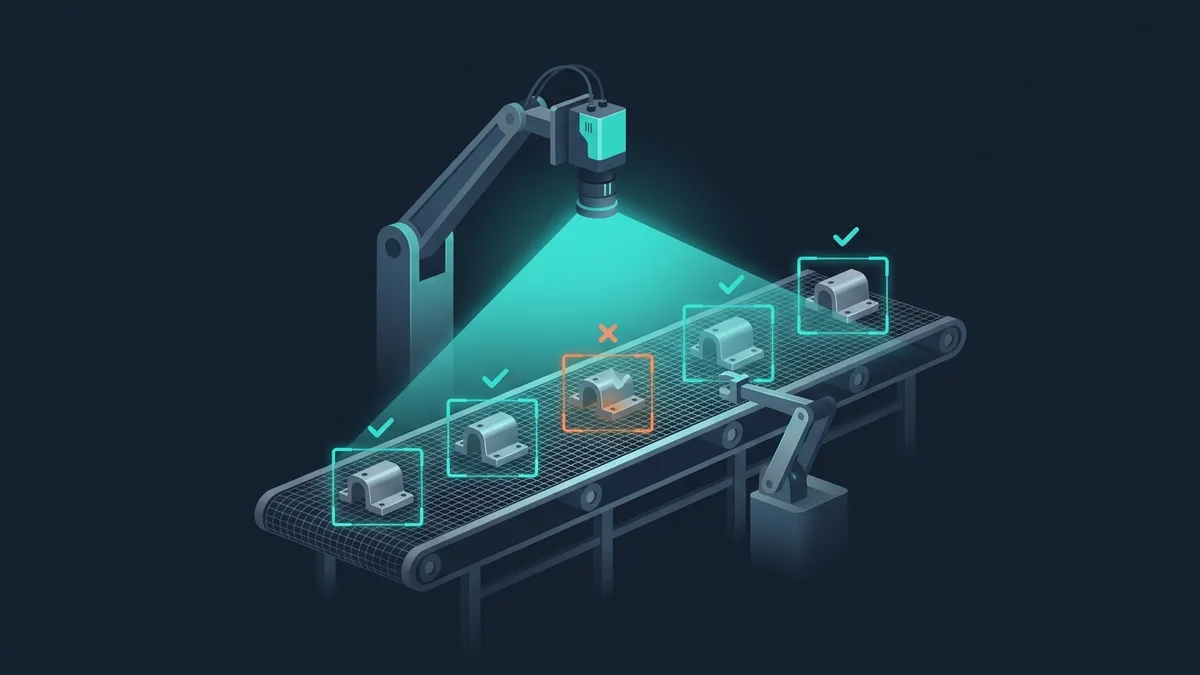
Video surveillance records a picture. Machine vision analyzes the picture and makes decisions. A warehouse camera simply records what's happening. A machine vision system on a conveyor detects a 0.1 mm scratch on a part, sends a “reject” command to the sorting mechanism and logs the defect in a database, all within 50 milliseconds.
Technically, machine vision consists of three components:
The key difference from video analytics: machine vision works in real time with industrial precision. Acceptable latency is 10–100 ms. If a part moves at 1 m/s, it travels 10 cm in 100 ms, so the system has to process the frame and issue the command before the part passes the sorting mechanism.
7 jobs machine vision does on the shop floor
Quality control and defect detection
Up to 60% of all projects. Finds scratches, chips, dents, cracks, foreign inclusions and dimensional deviations. A human inspector tires after 2–3 hours (accuracy drops from 95% to 70–80%); the system holds 99%+ around the clock. On a plastic packaging line it finds microcracks from 0.05 mm at 200 units/min: one camera replaced four QC inspectors, and customer claims fell by 85%.
Product counting and tracking
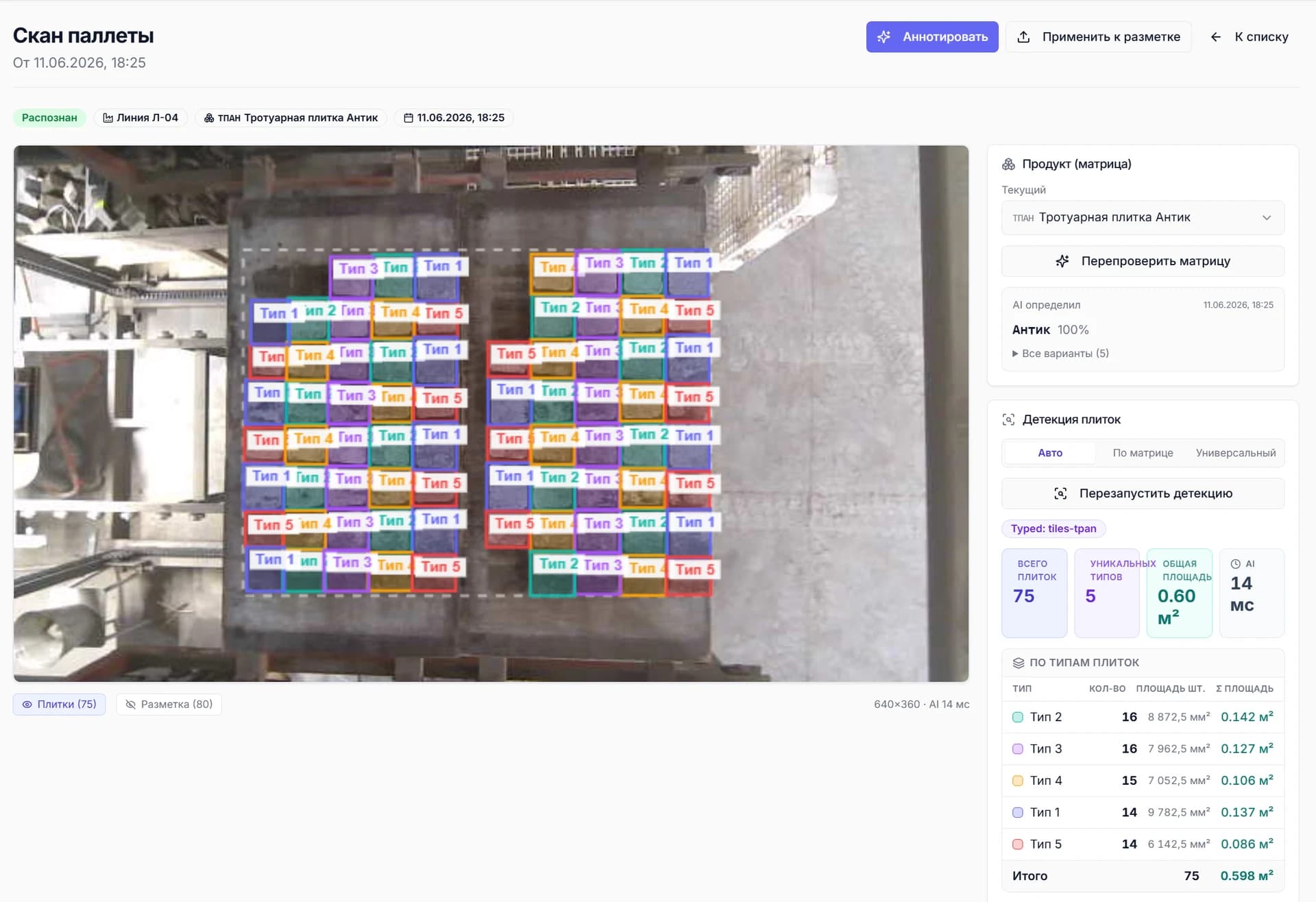
Counting units on a conveyor, on pallets, on racks. 99.9% accuracy at speeds up to 1,000 units/min. Especially valuable for small items (fasteners, hardware, pharmaceuticals), where manual counting is slow and unreliable.
Sorting and classification
Sorting by size, color, shape and grade. Food processing (fruit, grain), recycling, electronics (components). Up to 2,000 objects per minute, a pace manual labor can't match.
Reading markings and codes
OCR, barcodes, QR, DataMatrix. Checking labels, lot numbers and expiration dates. Relevant for pharmaceuticals (serialization and track-and-trace labeling), food and electronics.
Robot guidance and positioning
Machine vision “shows” the robot where a part is and how to grab it: bin picking, precise positioning during assembly, weld path tracking. Without it, a robot can only handle parts placed in a strictly fixed position.
Assembly and completeness checks
Checking that every component is in place: bolts tightened, connectors plugged in, labels applied. Critical in automotive and electronics, where a missing component means anything from a customer claim to a recall.
Equipment condition monitoring
Tracking wear on parts, fluid levels and surface condition. Predictive maintenance: the system spots conveyor belt wear 2–3 weeks before the belt snaps. The saving is the cost of downtime, which for a mid-sized plant can run to tens of thousands of dollars a day.
How a rollout works: from idea to launch
A typical project goes through 5 stages. It's not “buy a camera and it just works”: every stage matters.
Total from audit to launch: 10–20 weeks. Simple tasks (counting, codes) land closer to 10; complex ones (multi-class defect detection, 3D inspection) closer to 20.
Don't skip the audit and the prototype. They take 10–15% of the budget, but they answer the main question: “can this task be solved with the required accuracy?” Without a prototype you risk spending 70–80% of the budget only to find out the hardware isn't right.
What it costs: three price tiers
The cost depends on task complexity, the number of cameras, accuracy and speed requirements, and integration with MES/ERP.
What a one-camera MVP includes: industrial camera $1,500–6,500, lens $500–2,500, lighting $700–3,500, edge device or industrial PC $1,500–5,000, software development and model training $5,000–10,000, installation and commissioning $1,500–3,500. Monthly: support and monitoring $700–1,700; retraining when the product changes, from $1,700 on request.
Payback: an ROI calculation for a bottling line
Before: 4 QC inspectors on 2 shifts = $16,000/month, 92% accuracy, customer claims at 3.5% = $2,900/month. After: 1 operator = $2,300/month, 99.7% accuracy, claims at 0.2% = $170/month, support $1,000/month.
Savings: $15,430/month. Implementation: $40,000. Payback: 2.6 months; first-year ROI: 363%.
Machine vision isn't an expense. It's an investment with one of the best returns among industrial technologies. A 3–8 month payback isn't a marketing line, it's the average across our projects. The key condition is a well-defined task and a solid audit at the start.
Case study: real-time quality control
Here's what it looks like at a real plant: our ProControl project, automatic product inspection at conveyor speed where human inspection had dropped to 75–80% accuracy. Two industrial cameras, structured lighting, a YOLOv8-based neural network that detects 12 defect classes, integration with the PLC for rejects and with the MES for statistics.

When you DON'T need machine vision
Honesty matters more than a sale. In some situations machine vision isn't the best choice:
Low production volume
At 50–100 units a day, manual inspection costs around $500–700 a month. A system at $14,900 or more would take 2 years to pay back, which isn't justified. The practical threshold is 500 units per shift.
Subjective criteria
A neural network judges “does it look nice?” worse than a person does. If a criterion can't be formalized (size, color, shape), machine vision won't help.
A constantly changing product range
If your products change every week, the cost of constant retraining eats the savings. The technology pays off in serial production with a stable range.
Extreme conditions
Temperatures above 80°C (176°F), heavy vibration and aggressive environments require special hardware (enclosures, cooling) and make the project 2–3 times more expensive. Sometimes other sensors solve the problem more simply.
Machine vision vs video analytics: what's the difference
The two terms often get mixed up. Here's how they differ:
Machine vision means industrial systems for quality control, sorting and robotics. Industrial cameras, precision down to 0.01 mm, response in milliseconds. Entry price: from $14,900.
Video analytics means analyzing video streams from ordinary IP cameras: visitor counting, face recognition, event detection. Standard CCTV cameras, precision in meters or centimeters, response in seconds. Entry price: from $7,500.
Quality control on a conveyor is AI integration. Counting shoppers in a store is video analytics. Sometimes the tasks overlap: monitoring how busy production zones are can also be done with video analytics.
Which technologies are used
Neural network models
YOLO: real-time object detection (5–15 ms on a GPU) for defects, counting and classification. EfficientNet / ResNet: pass/fail classification with 99%+ accuracy. U-Net / Segment Anything: segmentation, meaning defect boundaries, damaged area and geometry.
Edge devices
You don't always need a powerful server. For simple tasks: NVIDIA Jetson Orin (from a few hundred dollars), industrial mini PCs with OpenVINO. The advantages: compact size, low power draw, no network required.
Cloud services
For tasks that don't need real time (analyzing photos after a shift, checking documentation): Google Cloud Vision, Amazon Rekognition or your own models in the cloud. Typically around $1–1.50 per 1,000 images.
Industry specifics
Food production
Quality sorting, label and marking checks, foreign object detection. The specifics: hygiene (IP67+ enclosures), wet and shiny surfaces.
Metalworking
Geometry checks (tolerances down to 0.01 mm), surface defects (pits, cracks, corrosion), welds. The specifics: reflective surfaces call for polarized or diffuse lighting.
Pharmaceuticals
Serialization and track-and-trace code verification, packaging integrity, blister completeness. The specifics: strict validation (GMP), so every decision is documented and reproducible.
Electronics
Solder inspection (cold joints, bridges), SMD component placement, micro-markings. The specifics: tiny dimensions call for 12+ MP cameras with telecentric lenses.
We work turnkey in any industry, from the audit and hardware selection to launch and support. More on AI integration in manufacturing. For video analytics (people counting, zone monitoring), see video analytics for business.
How to choose a vendor
The machine vision market is young, and vendor expertise varies enormously. What to look for:
Frequently asked questions
How much does a machine vision system cost?
A pilot module for one task or one defect type starts at $19,900 and is ready in 2 weeks. A simple one-camera setup (counting, OCR) starts at $14,900. A full quality control system, with the model trained on all defect types, cameras installed and integration with the conveyor and your ERP, starts at $34,000 and is built in stages. Turnkey implementation is covered on our machine vision for manufacturing service page. Support starts at $1,300/month. The final figure depends on the number of defect types, line speed and the number of cameras.
How many images do you need to train a model?
It depends on the task. Binary classification (pass/fail): from 500 images per class. Defect detection: from 1,000 labeled images. Complex classification (10+ types): from 300 per type. Augmentation (rotation, scaling, brightness) cuts the need for real data by 30–50%.
Can you use ordinary IP cameras?
For simple tasks (counting large objects, reading large codes), yes. For industrial quality control, no: rolling shutter (motion blur), 25–30 fps, no sync with the lighting, drifting auto-exposure. Industrial cameras have a global shutter, up to 500 fps, strobe sync and stable settings. They cost 3–5 times more, and the results are in a different league.
What accuracy is realistic?
Large defects (scratches over 1 mm, dents over 2 mm): 99.5–99.9%. Small ones (0.05–0.5 mm): 97–99%. Pass/fail classification: 99–99.8%. 100% doesn't exist: there's always a trade-off between false positives and false negatives. In manufacturing, missing a defect is the bigger problem, so the system is tuned to prioritize recall.
How much does system support cost?
Basic (monitoring, updates, consultations): $700–1,300/month. Extended (plus retraining, a 4-hour SLA): $1,300–2,700/month. Critical systems (the conveyor stops without machine vision): $2,700–5,000/month with a 1–2 hour SLA. Overall, expect 5–10% of the implementation cost per year.
Can we start with a pilot on one line?
That's the best approach: a pilot on one line starts at $19,900 for 2 weeks, and counting items or OCR with one camera starts at $14,900. You can begin with a free demo: send 100–300 photos from the line, and within 3–5 days you'll see the accuracy on your own products. The results give you the data to calculate ROI and justify scaling up. Each additional line is 30–40% cheaper because the model is trained, the architecture is chosen and the integration is in place. More on AI integration.