
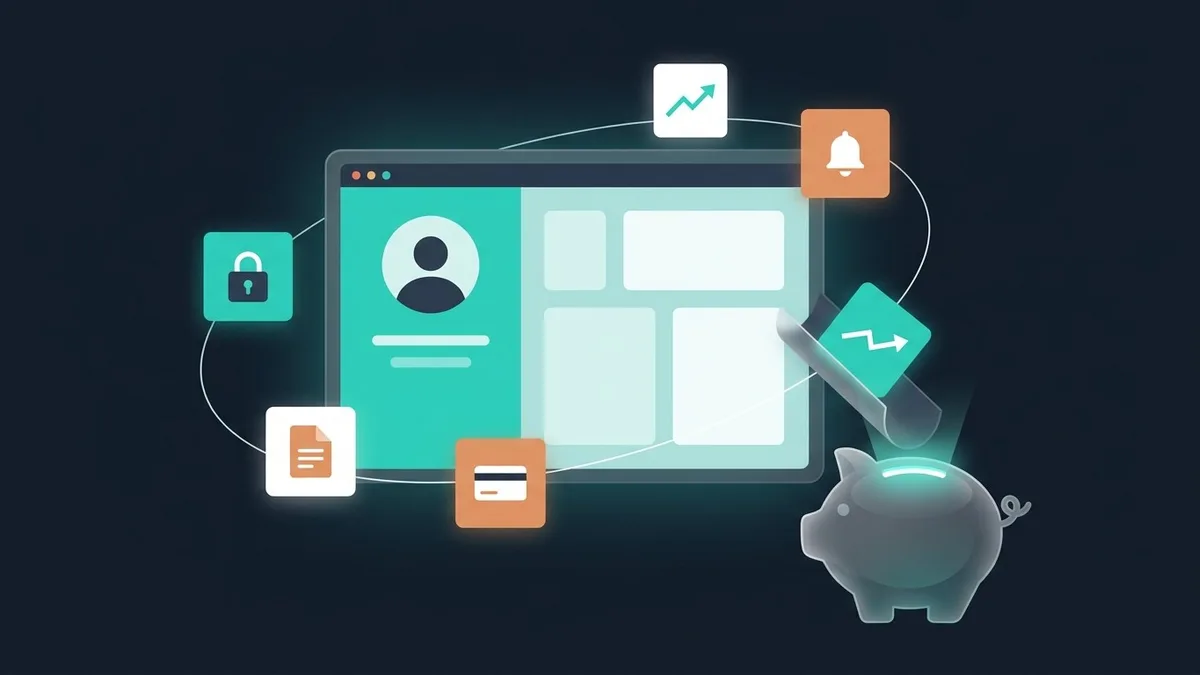

"We need a customer portal" is a phrase that can hide a budget anywhere from $9,900 to $170K. Because a "customer portal" can be a profile page with 3 fields, or a full portal with document management, payments, analytics and integration with five external systems. To get a sensible estimate, you have to break the job down into modules.
This article gives you a detailed cost breakdown by module, the tech stack, development timelines and a formula for a quick budget estimate.
(sign-in + profile + 1 module)
(5–8 modules + integrations)
from MVP to full version
What goes into a customer portal: modules and costs
A customer portal is a set of modules. The cost depends on which modules you need and how complex they are. Below are the typical modules with price ranges.
Sign-in and registration
Cost: $1,300–4,300.
Basic (email + password): $1,300–2,200. With SMS verification: +$500–800. OAuth (sign in with Google, Apple, Microsoft): +$700–1,300 per provider. Two-factor authentication (2FA): +$700–1,200. Sign-in with a digital certificate (for government agencies and B2G): +$1,700–3,300.
If all you need is email sign-in, it's simple. SSO (Single Sign-On) with a corporate Active Directory costs 3–4 times more, because it requires integration over LDAP/SAML.
User profile
Cost: $800–2,700.
Basic (name, email, phone, avatar): $800–1,300. Extended (company details, shipping addresses, payment details): $1,300–2,200. With verification (document upload, checking the company against official business registries): $2,200–3,300.
Document management
Cost: $2,700–8,700.
Viewing and downloading documents (invoices, statements, contracts): $2,700–4,300. Generating documents from templates: +$1,700–3,300. Legally binding e-signatures (through a provider such as DocuSign): +$2,200–4,300. Integration with e-invoicing or electronic document exchange: +$1,700–3,300.
Document management is often the most expensive module, because it needs an integration with your accounting or ERP system to get up-to-date data. Documents shouldn't just sit in the portal. They should be generated automatically from the accounting system.
Payments and billing
Cost: $2,200–6,700.
Online card payments (Stripe, PayPal or your bank's gateway): $2,200–3,300. Recurring payments (subscriptions): +$1,000–1,700. Account balance and top-ups: +$1,300–2,200. Account statements and payment history: +$800–1,300. Integration with your accounting system to reconcile payments automatically: +$1,700–3,300.
Requests and tickets
Cost: $1,700–5,300.
A request form with attachments: $1,700–2,700. Statuses, history, comments: +$1,000–1,700. SLA timers and escalations: +$1,000–1,700. Integration with a CRM or help desk (Zendesk, Freshdesk): +$800–1,700.
Analytics and dashboards
Cost: $2,200–6,700.
Basic statistics (orders, spending, activity): $2,200–3,300. Graphs and charts (Chart.js/Recharts): +$1,000–2,200. Export to Excel/PDF: +$500–1,000. Custom reports with filters: +$1,700–3,300.
Notifications
Cost: $800–2,700.
Email notifications (request statuses, new documents): $800–1,300. Push notifications (in the browser): +$500–800. SMS: +$500–800 (plus the cost of the messages). A Telegram bot: +$700–1,300. A notification center inside the portal: +$700–1,200.
Typical scenarios and what they cost
Here are three realistic scenarios, from simple to complex.
Scenario 1: an MVP for a SaaS product
Modules: sign-in (email + OAuth) + profile + billing (subscriptions) + basic notifications.
Cost: $9,900–$13,000.
Timeline: 6–8 weeks.
Example: an account area for a cloud accounting service. The user signs up, picks a plan, pays and manages the subscription.
Scenario 2: a client portal for a B2B company
Modules: sign-in (email + 2FA) + extended profile + document management + requests + notifications + accounting system integration.
Cost: $22K–43K.
Timeline: 10–14 weeks.
Example: a portal for a distributor's wholesale customers. The customer sees their orders, downloads invoices and statements, submits service requests and keeps an eye on their balance.
Scenario 3: a full-featured portal with analytics
Modules: sign-in (SSO + 2FA + digital signature) + verified profile + document management with e-invoicing + billing + requests with SLAs + analytics + notifications (email + push + Telegram).
Cost: $43K–83K.
Timeline: 14–20 weeks.
Example: a portal for a large B2B service with hundreds of clients, electronic document exchange and integrations with 5+ systems.
A formula for a quick budget estimate
If you need a rough estimate right now, use this formula:
Budget = (Number of modules x $2,700–4,300) + Integrations ($1,000–4,300 each) + Design ($2,200–6,700)
Example: 5 modules x $3,500 + 2 integrations x $2,500 + $4,500 for design = $27,000. A realistic estimate for a project like this: $22K–33K.
The formula is accurate to ±20%. For a precise estimate you need a specification that describes every screen and user flow.
Tech stack: what affects the cost
Your choice of technology affects both the cost of development and the cost of support.
Frontend
React / Next.js is the standard for customer portals. Fast rendering, SSR for SEO (if there are public pages), a huge ecosystem of components. Development cost: medium.
Vue.js is an alternative to React with a slightly lower learning curve for developers. A good fit if your team already works with Vue.
Backend
Node.js (Express/Nest.js): fast development, one language shared with the frontend (TypeScript). Cost: medium. Fits 90% of customer portals.
Python (Django/FastAPI): if the project involves ML or analytics. FastAPI for high-load APIs, Django for fast prototyping with an admin panel out of the box.
Java/Kotlin (Spring Boot): for enterprise projects with stricter security requirements. Development costs 25–40% more than with Node.js.
Database
PostgreSQL is the standard for 95% of projects. Free, reliable, scalable.
MongoDB: if the data structure differs a lot from one user to another (multi-tenancy with flexible schemas).
Infrastructure
Cloud (AWS, Google Cloud, Azure): from around $150 a month. A fast start and easy scaling. Fits 90% of projects.
Your own server: from around $500 a month (rental + administration). For projects with data residency requirements (GDPR, personal data).
Don't overpay for a "trendy stack." Next.js + PostgreSQL + a mainstream cloud covers 90% of what a customer portal needs. Microservices and Kubernetes make sense at 50,000+ users. For a start, they're overkill.
What makes development more expensive
Factors that increase the budget by 30–100%:
Complex integrations. Each integration costs from $1,000 (a simple REST API) to $6,700 (two-way real-time sync with an accounting or ERP system). Three integrations add $3,300–13,000 to the budget.
Mobile version. A responsive layout (works in a mobile browser) is included in the base cost. A mobile app (iOS + Android in Flutter): +$8,700–22,000. A PWA: +$2,200–4,300.
Multi-tenancy. If the portal serves different clients (a B2B portal), each with its own data, roles and settings, the architecture gets more complex: +20–40% to the budget.
Above-standard security. Encryption of data at rest, audit logs of every action, GDPR compliance, PCI DSS (for payments): +$2,200–6,700.
Custom design. A standard UI kit (Material, Ant Design) with minimal customization: $1,300–2,700. A fully custom design with UX research: $4,300–8,700. The difference isn't only about looks: a custom design improves usability and reduces the load on your support team.
Hidden costs
Things that don't make it into the initial estimate but always come up:
Testing. QA is 15–20% of the development cost. If you don't budget for it, you'll be testing on your users (and get a wave of complaints). For a portal that takes payments, testing is mandatory, because billing errors mean lost money.
Deployment and DevOps. A CI/CD pipeline, monitoring, alerts, backups. One-time setup: $1,000–2,700. Without it, every update is deployed by hand, and you learn that the server is down from your users, not from monitoring.
API documentation. If the portal is part of an ecosystem (it integrates with a mobile app, a bot, third-party services), you need API documentation: $700–1,700.
Support after launch. Minimum: $700–1,700 a month (hosting + monitoring + small fixes). Mid-level: $1,700–3,300 a month (plus ongoing development and new modules). Without support, the portal gradually ages: integrations break and vulnerabilities appear.
Real budget = development estimate x 1.3–1.5. Set aside 30–50% on top of the estimate for testing, DevOps, post-launch changes and the first 3 months of support.
How to save without losing quality
Start with an MVP. You don't need all 8 modules at once. Pick 2–3 critical ones (sign-in + profile + your main feature), launch in 6–8 weeks, collect feedback and grow it in iterations.
Use ready-made components. A UI kit (Ant Design, shadcn/ui) saves 30–40% on the frontend. Ready-made authentication modules (NextAuth, Keycloak) save 50–70% on the sign-in module.
Don't build a mobile app at the start. A responsive layout + a PWA deliver 80% of the mobile experience at 20% of the cost of a native app. Build the app once you've confirmed that your mobile audience is really active.
Prioritize integrations. Not every integration is needed right away. At the start, connect only the ones the portal can't work without (for example, your accounting system for documents). Add the rest as you grow.
More about our approach to development on the web app development page. How to write a specification that gets you an accurate estimate is covered in our guide.
Our approach: a customer portal from $9,900
At March Code we build customer portals on Next.js + PostgreSQL + Prisma. The typical process:
(2–3 modules)
after launch
Stages: 1) analysis and specification (1–2 weeks), 2) design (1–2 weeks), 3) development (4–12 weeks), 4) testing and launch (1–2 weeks), 5) support and development (ongoing).
If you already have a description of the task, start with our guide to building a customer portal so you don't miss anything in the requirements.
FAQ
Can a customer portal be built with a website builder (Wix, WordPress)?
Sort of, with plugins (MemberPress, LearnDash). But only for simple scenarios: access to content, a personal profile, basic subscriptions. A serious B2B portal with document management, accounting system integration and custom logic calls for custom development. Website builders break on the first non-standard task.
How much does customer portal support cost after launch?
$700–1,700 a month is the minimum (hosting, backups, monitoring, small fixes up to 8 hours a month). $1,700–3,300 a month is mid-level (plus ongoing development, new modules, optimization). $3,300+ a month is for high-load portals (DevOps, scaling, 24/7 support).
How long will a customer portal last before it needs a redesign?
With the right stack and architecture, 3–5 years without a major refactoring. A visual update (UI refresh) every 2–3 years costs $3,300–8,300. If the architecture is solid from the start, you can keep adding modules without limits.
Do we need a separate mobile portal?
In 80% of cases, no. A responsive layout + a PWA are enough. A native app is needed if users work in the portal every day (operational staff), you need push notifications (iOS limits push in PWAs), or you need an offline mode (installers, couriers, field staff).
What if the budget is limited?
Start with an MVP for $9,900–$13,000. The minimum set: sign-in + profile + one key feature (documents, requests or billing, depending on your business). Launch, collect feedback, then add 1–2 modules a quarter. In 6–12 months you'll have a full-featured portal, without the risk of spending $65K on something nobody uses.
How do you keep personal data secure?
A sensible baseline under GDPR and similar data protection rules: encryption in transit (HTTPS, TLS 1.3), password hashing (bcrypt), role-based access control (RBAC), activity logging, backups, a privacy policy and user consent. All of this is part of standard development. For stricter requirements (digital signatures, audit logs, encryption at rest): +$2,200–6,700 to the budget.